Some thoughts on the incumbents between 1660 and 1704
Note
This discussion is part of the Vienese heralds list.
The file name and the title are not consitent. I thought there is no discussion point in the eighteenth century, actually there is.
Assumed shift of incumbents chart

fig. 1: assumed shift of incumbents chart (click to show in original size)
Black line denotes where there is an occurrence; dark green dot line denotes record entry in HZABX.
Preconditions and assumptions
- Do not assume any unknown heralds. Sometimes it may be convenient to have such an officer, in this disussion, I satisfy myself with the available, or known, officers.
- All the known heralds held their respective tenures till their death unless there is any explicit evidence he left the office.
- No significant blank period was there between the two appointees. In next century we see many offices got dormant — there was no appointee after a vacancy, which, I assume here, is not the case in the period under discussion.
- The appellation Reichsherold does not necessarily mean the person in question was in one of the two Reichs.
The term usually just signified he was one of the five Emperor's heralds. See the sub-topic
Too many Reichsherolds.
Sub-topics (1) General discussion
End of "full promotion"
When Ferdinand I instituted his heraldic college, it had a promotion system, in which a herald is promoted from the most junior (Bohemia at that time) to
the most senior (Römischer at that time). Thus Francolin who styled himself Hungary in 1560 was
in 1565 Romanus and
Pellenstraß promoted from Bohemia (1560) to Germanicus (1565). Likewise Poinsot, Bohemia (1565), reached the highest position,
Römischer by 1582.
This is clearly confirmed by the 1624 petition. Here I call this "full promotion".
This system must have ceased to exit by 1704. From that year, the Yearbook started to record the then heralds' names,
by which we can trace the incumbents entrances and exits. We can here observe the promotion system had been applied to the two Reichs ("diminished promotion").
When did it end? This is a question whiche needs to be cleared to draw a chart which shows the shift of incumbents,
I will examine this backwards — starting from 1704, I will try to prove the non-existence of full promotion retrospectively.
Among the 1704 incumbents, the first person who catches our eyes is Haaß, as he was Austria in the 1704 list, and since 1661 he occupied the same position
(he was sometimes called Reichs — I will discuss this elsewhere later).
During the 43 years, there were a number of heralds died or left, yet he never got promoted. Does this mean full promotion ended by 1661?
One problem is, there was no instance someone who held Austria promoted to a higher office (i.e., Bohemia).
The 1624 petition does not mention Austria, which can be simply because the office was then vacant.
We can, however, also assume Austria was excluded from the promotion system, as it was a new addition by Matthias c. 1608-12 — not in Ferdinand's original plan.
Also, while other four offices are all Reichs in their respective own right, Austria was not. Even in the nineteenth century,
it was placed below Lombard-Venet, presumably because it was not a Reich.
The next person is Haßlingen: he was Bohemia at least from 1687 to 1704 (d. in the latter year).
It is obvious, despite the several departures of his fellow heralds during this period, he remained in the same position,
that indicates there was no more full promotion. If we go back further, his first mention as a herald occurred in 1681.
We here should bring the 1687 list — a full list of five heralds with titles as of 1687 (one of whom is Bohemia Haßlingen).
If the full promotion was active between 1681-7, the three senior colleagues must have entered the heraldic college before him, i.e., before 1681
with the order as mentioned in 1687 (P. Grädel – Heiß – J. K. Gögger). Is it possible?
The transition shown as fig. 2a is a possible option. This signifies, the full promotion came to an end by c. 1683,
when Heiß was driectly appointed to the Second Reichs. As Grädel filled the vacancy caused by Pfaller in 1678,
Heiß and J. K. Gögger must have come to the offices between 1678 (Grädel) and 1681 (Haßlingen). There was, however,
only one chance. If we put Heiß in 1681 as shown in fig. 2b, it will cause a conflict in 1683:
while Heiß needs to promote from Hungary to the Second Reichs (that means there was full promotion), Haßlingen
needs to remain in Bohemia, and J. K. Gögger needs to be Hungary directly (that means there was diminished promotion).
The conclusion from these is, full promotion ceased to exist by c. 1683. Note that it does not mean it really ceased in that year.
It could have ended before that also, which I will examine more in next section.
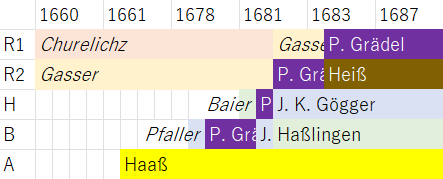
fig. 2a: theoretically possible option
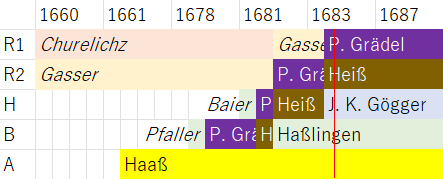
fig. 2b: conflict in 1683 with full promotion
Note: in both charts, Churelichz, Gasser, Baier and Pfaller do not necessarily reflect the actual appointments and vacations.
The two charts show a simulation just to prove non-existence of full promotion even if we make all the vacancies fully and deliberately available.
The 1660 list
We need to take another approach to give up going back more from 1681. Before 1681 back to 1660, other than Haaß, all the incumbents were mentioned as Reichs
in all their occurrences which makes it impossible to determine the precedence, who is senior and who is junior (and not to mention there is no complete list available).
Now the 1660 list shows the five heralds,
however without their titles. If we consider their seniority in terms of their professional career,
Beringer was the eldest (and also he occupies the top of the list), then comes Krautenhuber.
These two were, by far, must have been senior to the other three, and in terms of age also they were by far older.
As for the other three, Öllmann the son was a herald since at least 1652 (here again ignoring his title)
which can be further extended back to 1647 when his father died.
Churelichz was first mentioned as Bohemia in 1658. It is not likely Churelichz was senior to Öllmann as a herald,
as the former's professional career started only in 1654.
It is difficult to determine when Gasser started his career (even not as a herald). His record before 1660 is not known,
and also he died in 1683 implies he belongs to the same generation as the younger two. (If he belongs to the same generation as the older two,
we can expect his occurrence(s) long before 1660.)
As for the age, both Öllmann and Churelichz were born in the same year, 1621.
Gasser also may have been born in around the same year.
We come here to a problem: while the most normal precedence is R1-R2-H-B-A, it however does not align with their career nor age (for the latter, even though I never saw such a list).
1. Why did Krautenhuber come to the last, even junior to Gasser?
There is a mention to the former as a herald in 1637 (again ignoring his title — I shall discuss this later).
2. Likewise why did Churelichz enjoy the second highest position?
Or, was the list arranged like R1-B-H-A-R2? Does this make any sense? Why did this order need to be preferred, rather than the normal order?
My suggestion, then, is, R1-R2-A-H-B. To be honest, it more aims to solve the promotion system problem, and thus it makes the questions I have raised only "half-resolved".
That said, the precondition for this list in the first place is, it is not in a random order.
There must have been a background idea. This is kind of a belief. I do not believe, in those days, people did not stick
on the precedence in such an occasion as to be mentioned in a published book.
While A-H-B is rare and can be found in the 1702 list only, it still means the order makes sense (that is why it was adopted in 1702).
What is the good reason for this order? I will start with the question in the previous section, when the promotion system got shranken.
The sytem must have been dimnished in 1660 when the emperor restablished the heraldic institution.
There was a restablishment. Churelichz stated Ius Heraldis per Augstum LEOPOLDUM restabilitum
Opera Laurentÿ de Churelichz etc. 1660 in Churelichz 1661,
frontispiece. It was, in my understanding, a two-fold change:
1) one is change of system (a permanent change), 2) the other is change of nomination (or swap of the titles, and a one-shot change).
1) Under the new system, promotion is limited to the two Reichs, and other three officers stay in the same position
(the only exception happened in the nineteenth century, when the Kingdom of Lombard-Venetia vanished, Koderle promoted to Reichs (1866-8)).
I have no amibition to find out what was Leopold's motivation to make such a change. However, if we need to choose one occasion
when the change took place, it must be 1660. In other years between 1660 and 81 (as proven above as terminus ad quem), there is no clue to indicate
such a change.
2) If there was no more full promotion, Haaß' predecessor must be Öllmann (the other herald deceased in 1661 is Beringer who however died after Haaß' mention as Austria in that year).
Gasser (died in 1683) must be Hungary, as Haßligen was Bohemia from 1681. Then the last office, Bohemia goes to the last person, i.e., Krautenhuber.
This focuses, as already indicated, more on the promotion — to reconstruct the shift of incumbents.
On the other hand, I have no justification for why Öllmann and Krautenhuber were (probalby) obliged to be degraded to Austria and Bohemia, respectively.
As for the senior two offices, no one would object Beringer's (the first of the two) supremacy. He boasted, by far, the longest heraldic career. Also
he seems to have been the sole provider of the material for Flori Europæi, V.. Even J. C. Öllmann whose father
had been a herald since around the same time as Beringer, did not contribute anything. Krautenhuber also.
Churelichz, the other of the two and the last person to examine, is the only herald who had the right to get promoted.
He had been active since 1658 when he published his first (I believe it is the first) work and would publish more volumes towards 1666 (see his biography). He must have been instrumental for the heraldic part of
Flori V as can be understood by the sentence Penes Heraldum Cas. Laurentium de Chureliz in the title page. The work was the first (and the only) attempt to
describe the overall picture of the heraldic institution at the Vienese court (the quality is not comparable with
the English heralds works, still this is something the French heralds never accomplished).
This is another proof to believe there must have been kind of momentum that renovated the institution, of which he was the leading figure,
even though we do not know whatsoever background there lies (or, was it
Churelichz's personal zeal? — for now it cannot be confirmed).
Now we got two conclusions, one for the order of the 1660 list, and the other for the start of the dimnished promotion.
Based on these, and the occurrence of the heralds, together with some assumption, we can reconstruct the shift of incumbents.
If I can point out one more thing, institutional change always happened in the starting years of the then monarch's reign:
Ferdinand I's foudnation of the heraldic college, Matthias' (re)introduction of the Austrian office, Joseph I's creation of Wappen Inspektor.
Of course this can be mere coincidence. As I shall show later, the separation between Hoffouriers and heralds seems to have been
completed towards the end of Leopold I's reign, there is at least one exception.
Too many Reichsherolds
In this section I will examine my assumption (see above), the appellation Reichsherold in those days must have meant any herald who served the Emperor.
Of the 20 incumbents under current consideration, only two (Haaß and Haßlingen) were styled other titles than Reichs
when they were mentioned separatedly from their other colleagues (obituary, for example).
Even Haaß and Haßlingen were called Reichsherold (see below).
Since they never got promoted, it is impossible they held the senior office in the middle of, and at the end of their careers.
There are other such occurrences as shown below.
In a reversed manner, sometimes all the five heralds were collectively called Reichs-.
This happened in 1666 and 1681.
Similarly in 1627, they were all styled Kaͤyserl. Herolden.
Table 1
| Name of the officer | Actual title | Occurrence | Source and/or remarks |
|---|
| Martin Lorenz Preger | Bohemia | Jul. 1602 | Title is assumption. |
| Tobias Güntzel | Bohemia | 17 Mar. 1611 |
Einnahmen- und Ausgabenrechnung des Hofzahlmeisters
1611 März 17, Prag
... an statt hechsternenter ihrer Kay: Mt. etc. Reichs Heroldten herrn Thobiasen Günzl, ...
Title is assumption. |
| Haaß | Austria | 1683 | |
| Haßlingen | Bohemia | his obituary | |
| Wilhelm O'Kelly | Austria | Mar. 1714 | |
| Franz Friedrich Pöck (Bock) | Austria | 1728 | Not sure if he was mentioned as such in the original text. |
There was certainly a German preference for the title Reichsherold.
(This can be understood as a sign of a schism which put an end to a medieval unitary heraldic institution among the countries;
also why was it Herold, and not Reichswappenkönig? —
they wanted something like Wappenkaiser who serves the Emperor...? Probably
we should consider that the emergence of Reichsherold coincides with disappearance of pursuivants in the German world).
It is beyond my ambition to here give an extensive survey on the origin and
development of the term, still I shall touch upon its history to make my conclusion I stated at the beginning of this section more convincing.
The ever first Reichsherold formally mentioned as such occurred in 1582 when Martin Stöckl (or Stöckel) was styled Reichs Heroldt.
As he was most likely promoted on Hans Francolin's death (or retire) c. 1580, the office Reichsherold also must date back to that year
(note: I am concerned with the Reichsherold at the Vienese court, meaning, it is possible there could be
another Reichsherold elesewhere earlier than 1580 — Dennmark or Sweden, for example).
However, it seems, long before Stöckl, the Emperors' heralds styled themselves by that title, and it became a commonly used title to refer them.
As far as I searched, the first two events in which Reichsherold are mentioned occurred in
1474,
when Romreych was called as such: des Reichs Eerenholden Romreych genannt
(with the premise it is correct to understand des Reichs Eerenholden is the precursor or Reichsherold).
However this is a retrospective mention, as the manuscript was compiled c. 1555-9 (still it is before 1580).
(Note, before 1474, there was:
Romerich ayn kunyng der
wappen des heiligen Romyschen reiches und Erhalt in
Grant in German by Romerich, king of arms of the Holy Roman Empire ... Dated at London on
the Feast of the Nativity of St. John Baptist, 1467, in
Proceedings of the Society of Antiquaries of London,
Second series, vol. 16, 1895-7,
pp.341-2.
(Internet Archive.)
See also
37687 ... A. Grant by "Romerich ayn kunyng der Wappen des heiligen Romyschen reiches" ... 1467,
Catalogue of additions to the manuscripts in the British Museum in the years 1906-1910, BM, 1912, p.111 (Internet Archive) and
Add MS 37687 A - British Library Archives and Manuscripts Catalogue.
I am, however doubtful of the authenticity of this grant. So far this must be the only grant of arms by a German King of Arms.)
The first contemporary (and unsuspicious) mention I could find is that of 1526 (see the table below).
From that year on, there were numerous mentions.
| Year | Mention | Source and/or remarks |
|---|
Table 2
| 1526 | ... Thurnier Buech
Durch des Heiligenn Romischen Reich Erolden Jorgenn Rixnern genannt Jerusalem... |
Kurras 1982,
p.342.
This mention is confirmed by the catalog: Nürnberg, Germanisches Nationalmuseum. Bibliothek, Hs 3994 a,
in which
fol.81-123 gives
Rixner, Jorg, Des Heiligen Römischer Reich Erold... .
As far as I checked,
Kolde 1907 and
Kurras 1982 did not give any earlier and contemporary use of Reichs-Herold |
| 1530 | des Reichs Erenholdt / genannt Germania | |
| 1530 | Jhrer Mayest. vnd deß Reichs Ehrnhold / genandt Burgundia |
Note that the compiler observed
jetzo dessen Successor in Niderland Re des armas genennt. They understood Reichsherold is equivalent to Roi d'armes.
Burgundy was once a kingdom, by which virture the author called him des Reichs Ehrnhold...? |
| 1533 | des hailigen römischen reichs ernhold | |
| 1534 | K. M. vnd deß Reichs Erenholdt | |
| 1538 | Roͤmischer Keiserlicher / Auch ewer Koͤniglichen Maijestat
Vnnd des Reichs Erenholdt | |
| 1540 | des Römischen Reichs Ernholdt | |
| 1541 | Roͤmischer Kayserlicher Mayestat vnd des heyligen Reychs Eerenholt | |
| 1544 | Roͤmischer Keiserlicher Maiestat / vnnd des Heiligen Roͤmischen Reichs / Ehrnholdt | |
| 1559 | zwen Kayserliche Reichs-Ernholden | Ever first use of Reichss Herold in the exact form.
Also here the two Reichs-ernholden are in contrast with die zwen Ernholden von Hungern vnnd Boͤhem. |
| 1565 | die zwene Keyserliche Reichs Ehrnholde | |
| 1567 (1) | des Reichs Ehrenholde | |
| 1567 (2) | des Reichs Ehrenholde | |
| 1569 | der Römisch kais. maj. und des heiligen Römischen reichs ernhold | |
| 1570 | durch die
fuͤnff Reichs Herolden | |
| 1573 | der hailigen reichs ehrnholden | |
| 1575 | dess heiligen Römischen Reichs Ehrenholdten | |
What the term Reichs signifies is ambiguous. Theoretically, Hungary and Bohemia are also Reich per se, same as
Sweden,
Norway and
Bavaria. In fact, in the eighteenth and nineteenth centuries, there are narratives which describe the coronations or oaths mention Hungarian Reichsherold
(curiously however, I could not find any Bohemian instance). The occurrences include:
1712,
1741,
1792,
1825,
1830.
The examples given in Table 2, on the other hand, show the special reference to the Heilige Römische Reich: des hailigen römischen reichs ernhold or des heyligen Reychs Eerenholt.
The 1559 instance gives the most definite and distinct picture of the office in the form of two Reichsherolds are opposed to the other two heralds, one Hungary, and the other Bohemia,
that must denote, only the two (Römishcer and Deutscher) represent the Reich. King of the Romans and that of the Germans were kind of pre-requisite to be an Emperor
while Bohemia was not, and Hungary was even not a part of the Empire. Here the Reich premises more Imperial sense.
As a consequence, the two offices needed to change the title to Kaiserlicher östereichischer Herold in 1807
when the old Reich came to an end.
The new empire was, unfortunately, not a Reich but a Kaisertum.
However, the story could be simpler, that those who look like a Reichsherold were called as such.
The senior two must have worn the tabard with a Reichsadler, and a herald with Reichsadler — he is a Reichsherold.
There was one more such usage that the two junior officers in Reichsadler to act in the capacity of Reichs.
In the sixteenth and seventeenth centuries the Emperors' heralds were busy to travel within the Empire for making declaration
(mostly for Reichsacht). Such an announcement needed to be done by a Reichsherold or an Emperor's herald (and not by a Hungarian nor Bohemian herald).
That is why Pierbaumer and Preger both of whom must have been then Bohemia were called Emperor's herald and Reichs Herold.
J. C. Öllmann also was probably Hungary in 1652, as Beringer occupied the First, and Krautenhueber (with lesser possiblty than Beringer) occupied the Second.
Likewise Krix can join the group when he styled himself Imperii Heroaldum in 1595
in that year he must have been Bohemia.
The following list summarizes the several usages:
1) Reichsherold as a generic term to denote all the heralds or any herald who served the Emperor.
2) Reichsherold as a generic term to denote any herald who represented any Reich. See especially the Hungarian examples shown above.
3) Reichsherold as again a generic however more specific term to denote the senior two heralds who represented the Empire. Later it became the formal heraldic title for them.
4) Reichsherold in appearance, the heralds with Reichsadler (usually those who belong to the third category).
There is kind of laziness here which however cannot deny the idea that, for most of the people in those days,
he looks like a Reichsherold, that is why they understand he is a Reichsherold — this only was the practically available definition for them.
5) Heralds acting in the capacity of Reichs (thus they fall in the fourth category also).
Back to our question, the problem for the current discussion is, a Reichsherold occurrence does not necessary mean the herald was a Reichsherold in the third sense.
Nepotism and end of Hoffourier-Herold
Note: this discussion impacts on the last c. 10 years of the timespan under concern.
The period under our discussion is marked by nepotism. While in England, France, the Low Countries, and Spain, we observe many heraldic dynasties,
at the Vienese court it was quite sparse, After 1559 down to the fall of the Empire, all such occurences are found in these c. 40 years,
except one Strobl case which occured in the middle of the eighteenth century (note that
1. I counted heraldic dynasties, i. e., heralds more than one generation only. Besides those I mentioned, there was Poinsot
dynasty, which was founded by one Johann the father who was a Hofquartiermeister (and not a herald) followd by
Johann the son who rose to Römischer. See
AT-OeStA/AVA Adel RAA 322.35 Poinsott, Johann, Johann, sein Sohn, kaiserlicher Herold, Adelsbestätigung, Wappenbesserung, 1564.11.28 (Akt (Sammelakt, Grundzl., Konvolut, Dossier, File))
(here in my understanding, the son was kaiserlicher Herold) and
AT-OeStA/AVA Adel RAA 322.34 Poinsott, Johann, kaiserlicher Hofquartiermeister, Adelsstand, Wappenübertragung vom Vetter Johann Poinsard, 1559.07.20 (Akt (Sammelakt, Grundzl., Konvolut, Dossier, File)).
See also
AT-OeStA/AVA Adel RAA 322.33 Poinsard, Johann, aus Hericourt, Wappen mit Lehenartikel, 1548.06.04 (Akt (Sammelakt, Grundzl., Konvolut, Dossier, File)).
This is kind of half or semi heraldic dynasty. There can be more such occurrences.
2. I did not check the female line
through which there can be more instances). All the founders were Hoffouriers,
this must be because, heralds had been no more a profession to chase its career (like from pursuivant to king of arms),
instead a position which can continue to exist only by an incumbent who already secured another position.
(How did, on the practice level, they succeed? Was there any kind of survivance by which the father secured his post in favor of the son?
At least, the Gögger dynasty was not realized by it, as, the father surrendered in favor of son, i. e., not through inheritance;
and if it was by the virtue of survivance, how could Johann Christian Wilhelm complained about it?
This is a question yet to be surveyed.)
Hoffourier had been since 1554 the major supplier of heralds. In that year under Ernholdt,
Quartiermaister and Hof Furier were listed together, and among whom we can find two (future) heralds, Thomas Dorner (or Thorner) and
Hans Francolin, the famous herald. In the 1612 Hofstat of Rudolf II and
of Matthias, there are total three Hoffouriers
who would be heralds in the coming years. The 1653-4 list shows three (the then incumbent or future) Hoffourier-Herolds.
This is probably because of their overlapping functions in the sixteenth and seventeenth centuries.
During this period, heralds often traveled into the Reich, mostly to declare the Imperial Ban.
The Hofquartieramt was responsible to organize and prepare such travels (Rescher 2016, p.96). It must be convenient
(at least for whom who commands such missions) the one who arranges and the one who goes are the same person (or belongs to the same office).
Of the 20 heralds examined in this discussion, 10 held Hoffourier office concurrently, at least for a while; 3 were also Hoffouriers however they were one-shot heralds;
2 were sons of Hoffouriers however they themselves were not Hoffourier. The heralds who form the three dynasties
(yes only three) are included in this list, except J. C. Öllman's father Johann Öllman who was also a Hoffourier.
Hoffouriers could make influence the recruiting of heralds as we can observe in J. K. Gögger's case, and
that is (and simply that is) why the founders of the three cases here were Hoffouriers.
If it is the case, it is not comparable with the court arms painter Krahls for whom it was a kind of family business (same as heralds in England and elsewhere).
The 1687 list shows the the hight of the nepotismic recruitment: Other than Haaß, all the four heralds came from the Hoffourier pool.
Probably this monopoly cauesd the anomaly of the three heraldic dynasties (however this in turn brings another question,
why during this period, were the Hoffouriers so successful in securing the heraldic offices).
By 1687, at the same time, trend had started to change.
The 10 Hoffouriers can be further divided into two groups: the earlier group, J. C. Öllmann, Krautenhuber, Liedel, Pfaller, and possibly Baier
held the two offices concurrently till their respective death, while the later group,
Grädel, Haßlingen, Heiß (probably), and Faber left one of the two offices sometime after they held the two offices concurrently
(the last one, J. K. Gögger also but his career was somewhat irregular; see below).
In the ever first Yearbook, the 1702 Yearbook, Hoffouriers and heralds were no more listed together (compare with the 1554 list).
In the next Yearbook, the 1704 Yearbook, the Hof-Quartier-Ambt was placed under Instanzen, ... Expeditionen, als Aembtern, ..., pp.1ff.,
while heralds were under Hof-Staat, pp.160ff.,
making the two offices completely separated (with the premise the Yearbook reflects the actual organization structure).
The former was subordinate to the Hofmarschall as told by Rescher (Rescher 2016, p.96).
The latter must have been subject to the Obrist-Hofmeister
(p.161),
under whom were those who were responsible to
Küche und Tafel, Ärzte und Chirurgen, Kapelle, etc. (Rescher 2016, p.4), and
in the Yearbook also heralds were mentiond together with them — in the same page were, for example,
Mund- und Hoff-Koch, or Hoff-Medici.
That meant heralds were expected to serve the Emperor for his body (but how? entertain visually by the gorgeous outfit?).
It can be compared with the Wappen-Inspektor who was under Reichs-Hof-Cancelley, Lateinischer Expedition, and thus
underAemter, not part of the Hof-Staat (see the 1706 Yearbook,
p.93 for example).
This more implies, at some time before 1702, heralds were transferred from under the supervision of Hofmarschall to that of Hofmeister.
Although the Hofquartieramt yielded many heralds, they had been from time to time listed along with the servants who were
in charge of Wohl des Kaisers (Rescher, p.4).
In 1582, heralds were mentioned with Leib-Medici,
Leib Cammer diener, Quardarobe which can be observed in
1594 also.
Similarly the 1612 Rudolph's Hoff statt did not mention heralds together with Hoffurier, instead they were
followed by Schneider, Hoffparbierer, Wundt Arzt, etc.
It is possible to assume, while on a practice level, Hoffourier-Herold was convenient, heralds per se was thought
to be an office which serves Emperor's person.
Two contrasting ideas on the nature of the office, and two contradicting processes of transition. It is beyond the scope of this discussion to
bring one single story to explain all. What I can say for now is, toward the end of the seventeenth century,
there was some change in the heraldic institution. It is likely the change was not part of a bigger restructure on an entire court level.
As far as I checked, there was no such major re-organization in this period.
One more question is, just after this period, in c. 1705 the Wappen-Inspektor was created, and William O'Kelly
who held the Austrian herald's office was its first incumbent. Is there any link between this new office and previous change?
Do these form a series of events within one scheme? This aain is beyond my scope;
yet I needed to bring this topic as, when, and how the transition took place impacts on the
period c. 1690 to 1702. I will come back to this when I disuss about Faber and Heiß.
Sub-topics (2) Officer specific discussion
What I have concluded in the previous sections covers most of the shifts and replacements of the officers during the period under current concern.
There still remains several incumbents whom I need to more closely examine. Same as previous sections, I will start from the end of the period and go backward.
Faber, Heiß and Dausch (and the Grädels)
Faber was the last Hoffourier to be appointed a herald. As already shown, there was certainly a change of trend
toward the end of the seventeenth century.
His appointment must have been before that. There is, however, some difficulty to determine the start and end of his tenure.
As for the end, his successor must be Dausch who was mentioned (only once) as a herald in Feb. 1703.
Faber on the other hand was in his heraldic office on 26 Dec. 1702, again this is the only instance he occurred as a herald
(I do not here argue the inconsitency of his first name, but question remains).
He then must have left sometime between these two dates. We cannot be more precise.
The start date is much more difficult. I presume he succeeded Heiß. The other option for his predecessor is Grädel the father.
Of course, we should expect there was a Grädels' succession for which, we however have no evidence to validate.
If we need to bring something supportive,
we can point out that, in that case, Faber's tenure will be between c. 1701 (the older Grädel's death and c. 1703.
This means, the Hoffourier-herald practice came to an end in between these about three years (in 1701 a Hoffourier (Faber) was chosen to be a herald,
and in 1703, instead of a Hoffourier, a Cammerfourier (Dausch) was favored). Was it really the case?
Heiß, the more qualified predecessor's heraldic career got obscure toward the end of the century. His last mention as a herald occurred in 1692
while his record as a Hoffourier regularly appeared on HZABX down to 1702, the year of his death.
This does not, however, necessarily mean he left the office in 1692. There was no single entry for Gasser's heraldic activity.
And, that will be same for Heiß' successor (of which Faber is the only option) if the former really surrendered his office in 1692,
the new herald also lacks his trace, unless we assume a long vacancy, which I exclude in this discussion as I stated in the precondition.
There is no reason to believe of making heraldic offices dormant in this period (even under Charles VI and Mary Therese,
yes Hungary and Bohemia experienced such a situation, it was not the case for the two Reichs).
One may question, if Faber came to the office in 1692, he needed to jump over his senior colleagues' heads.
We are, so far, not so much sure for the mechanism how the seniority among Hoffouriers brings the precedence to be awarded a herald's office.
The 1677 Hoffourier list puts Grädel in the second highest position.
Before he was appointed to Reichsherold, however, there were three Hoffouriers who were made heralds, J. K. Gögger, Pfaller, and Baier
(their respective dates of appointment is based on assumption with varied ceratainty, among which, at least, Pfaller's only chance is Liedel's death).
We can, of course, assume Heiß was in his heraldic office until his death. He died on 11 Oct. 1702 shortly after that his (supposed) successor
Faber was first (and last) mentioned, as already stated, on 26 Dec. 1702. This again makes the latter's tenure extremely short.
It brings some doubt if it was really the case.
Comparing Faber's (and Heiß') career with other Hoffourier-heralds brings some hints.
Being a herald after having been a Hoffourier for two years (Faber (1)) seems to be a too quick rise.
Keeping herald's office for 1 year before leaving it (Faber (2)) also needs a convincing reason as already stated.
(Heiß' three options are all okey as far as I observe.)
1696 (Faber and Heiß (3)) is the year when Faber became a herald to succeed Heiß, this is my conclusion for now.
Balancing between the several heralds' careers is the only supporting factor for this. This could be corrected or updated with new sources or information.
As already repeated, this was the last occasion a Hoffourier was created a herald. Probably there was no question on this practice in this year.
Climate had been changed by the time when Faber surrenderred the award. This again needs new sources and information.
Table 3
| Name | A: Born | B: Appd Hoffourier | C: Appd herald | D: Left one of the offices |
B - A | C - A | C - B | D - B or C | D - A | Remarks |
|---|
| Krautenhuber | 1594 | 1624 | 1637 | N/A |
30 | 43 | 13 | N/A | N/A | |
| J. C. Öllman | 1621 | 1647? | 1647? | N/A |
26? | 26? | 0? | N/A | N/A | Note that he belongs to the second generation.
J. B. Gögger was appointed when he was 20, and M. P. Grädel was 32. |
| Liedel | ? | 1646? | 1662 | N/A |
? | ? | 16? | N/A | N/A | |
| Grädel | 1629 | 1661 | 1678 | 1683-4 |
32 | 49 | 17 | 5/6 | 54/5 | |
| J. K. Gögger | 1635 | 1661 | 1670 | 1676? |
26 | 35 | 9 | 6 | 41 | For his heraldic career, here shows his (assumed) first tenure. |
| Pfaller | 1636 | 1667 | 1677 | N/A |
31 | 41 | 10 | N/A | N/A | |
| Baier | ? | 1670 | 1676 | N/A |
? | ? | 6 | N/A | N/A | |
| Heiß (1) | 1640 | 1677 | 1681 | 1692 |
37 | 41 | 4 | 9 | 52 | Suppose if he left his heraldic office in 1692. |
| Heiß (2) | 1640 | 1677 | 1681 | N/A |
37 | 41 | 4 | N/A | N/A | If ... on his death. |
| Heiß (3) | 1640 | 1677 | 1681 | 1696 |
37 | 41 | 4 | 15 | 56 | If ... in 1696. |
| Haßlingen | 1646 | 1674 | 1681 | 1689 |
28 | 35 | 7 | 15 | 43 | |
| Faber (1) | 1655 | 1690 | 1692 | 1703 |
35 | 37 | 2 | 11 | 48 | Suppose if he succeded Heiß in 1692. |
| Faber (2) | 1655 | 1690 | 1702 | 1703 |
35 | 47 | 12 | 1 | 48 | If ... in 1702. |
| Faber (3) | 1655 | 1690 | 1696 | 1703 |
35 | 41 | 6 | 7 | 48 | If ... in 1696. |
The three one-shot Hoffourier-heralds
The three Hoffourier-heralds who occurred for once in 1690 were one-shot appointee. No more than it, no less than it. For our current discussion there is no space to place them (and they do not have the right to claim any seat).
The three intrudees, Grädel, Haßlingen, and Haaß
remained in their respective offices till their (again) respective death. There were other two ordinary (if we can call them as such),
Heiß and J. B. Gögger, of which, the former resigned as a herald c. 1696 (this is my assumption discussed in the previous section).
By that year, Görz, one of the three intruders had already departed this life.
Other two seem to have not successfully secured this only chance.
By April 1701 when Grädel, the first one of the then oridiary to leave this life died, Crocus had left the Hoffourier office in 1699 and shifted to Wiener Rat.
Lastly in October 1701, Kraus followed Grädel. Theoretically, he could compete with M. P. Grädel
if the condition allowed (we do not know, Grädel the son had some priority or not). Not sure however, considering his age, if he really had such an ambition to apply for the position.
However again, we even do not know if they were even intruders or not. We do knot now anything about the background why the three
played heralds' role just for one occasion. I dedicate the rest of this section for some thoughts around this. (Just thoughts without any conclusion.)
One question we need to put in mind is, if this one-shot appointment was common or exceptional. Also, one more factor we need to consider is,
that in that occasion, four were Hoffouriers, and the last one, J. B. Gögger was a son of a Hofquartiermeister.
As far as I searched, at the Vienese court, the 1690 occurrence was the only instance any collective one-shot appointment was made. The lack of sources in most part of the seventeenth century makes it difficult to make this a final conclusion.
We shall not, for now, abandon the option that this was a normal practice.
The simplest answer we can assume why there was such a practice is, there was simply a resource issue, i. e., the ordinary officers could not attend the ceremony due to itinerary schedule or by any reason.
If it is the case, the Hoffouriers were chosen just because they were easy to hire. However we can point out, why then
1) the two ordinary officers (Heiß and J. B. Gögger) could join, and 2) why the two did not act in the capacity of their original titles.
It is, then, reasonable to assume they were Joseph I's officers. Maxmilian II tried to have his own heralds in 1564,
Matthias apparently dismissed his elder brother's heralds. Same could happen in 1690.
If it is the case the plan must have been not to make one-shot officers. It however failed for some reason (what was it?) and brought no fruit.
Here again there comes the question why the two officers served two monarchs.
In either case the appointments look somewhat arbitrary. In place of Grädel who seems to have had left Hoffourier office,
Heiß was raised to the First Reichs (was the Second Reichs, in the appointment in ordinary), and J. B. Gögger who was by far the youngest of the other seven (both ordinary and one-shot in total) heralds
occupied the Second Reichs vacatd by Heiß. Haßlingen who also was no more a Hoffourier and
Haaß who was never a Hofffourier were both intruded. This means the new and intruding appointments were more to replace the current incumbents
(than to provide temporary solution).
Just to make an ad-hoc appointment, or to institute a separate heraldic college, this kind of manipulation must have been not necessary.
We can assume, behind the screen, there was J. K. Gögger, the Hofquartiermeiser.
In 1689 — just before the 1690 one-shot appointments — Johann Christian Wilhelm complained about the appointment of the son of the Hofquartiermeister to the Hungarian herald's position.
If there was such a plot, however, why it was reverted (as it seems) in just around one month? Was it just because it was hastily planned?
Plot was there, but the appointments could be made for Joseph I only, was it the case?
At any rate, despite or because of the plot (if there was any), in the next century the Hoffourier-herald system (or practice) ended completely.
J. K. Gögger remained in office till his death in 1714. His son, J. B. Gögger found his fortune in another branch of the government.
In his entire career, the branch of the father's patronage must have occupied little part, which the son left c. 1729.
He made a brief come-back in 1740-1 (this deserves another discussion), then left it for the second time. He left this life in 1756, however having had no connection with the heraldic office in his last years.
Gögger and Baier
J. K. Gögger seems to have had a curious ambition in his career.
He was the only person who was known to hold the Hofquartiermeister and herald offices concurrently. His first mention as a herald
occurred in Jan. - Feb. 1676. Then his heraldic career
must have started c. 1670 to succeed Krautenhuber as Bohemia (if we consider his origin, this was a good coincidence for him).
He however participated the 1687 Hungarian coronation as Hungary. He did not, however again, rise to the higher office by promotion.
In Apr. 1676, just after J. K. Gögger was first mentioned,
there occurred another herald, Johann Conrad Baier. To make a seat available for the latter, someone needed to leave
the office. The one must be J. K. Gögger. If we consider the conclusion (so far) brought by the full promotion and the 1660 list precedence,
only he could leave and come back without hindering it.
If it was J. K. Gögger, it explains J. K. Gögger — Baier — Haßlingen Bohemian succession.
Baier died in early 1681 and in the same year Haßlingen occurred as a herald who the latter was Bohemia in 1687.
If it was someone else, J. K. Gögger's career did not experience interruption, that means, as he was Hungry in 1687,
he reached there by promotion, or from the start he was Hungary. The former violates the conclusion for promotion system, and
to make the latter possible, his predecessor Krautenhuber must be Hungary which again interferes with the previous conclusion.
We can check the possibilty for the then four other heralds who however have difficulty to be an option.
They are Churelichz, Liedel, Gasser, and Haaß.
Churelichz styled himself an Imperial Herald in 1675 and 1676, then his death register in 1681 also styles him as such.
HZAB (HZABX, l. 6264) records Liedel as a Reichsherold in 1674, 1676, 1677, 1678, and 1679 (the latter two must be retrospective ones).
The other two do not have enough proof for the period under the current concern.
However, as for Haaß (unfotunately his record as explicitly a herald in HZABX l. 3702
lacks during the period in concern), he was invariably mentioned as Austria throughout his career.
That means if he left the office once, he left Austria once and came back to the exactly same office.
It is as if he ceded his office just in favor of Baier. As far as we cannot find justification for this,
we have no reason to more prefer Haaß than J. K. Gögger.
The last one, Gasser first needs to shift the office from (the supposed) Hungary to Reichs in favor of Krautenhuber and J. K. Gögger.
And Churelichz needs to shift to Bohemia. Then the Hungarian line will be Krautenhuber (1660-1670) — J. K. Gögger (1670-1689).
However, the bigger problem is, how he became a herald again. Yes there is no record for Gasser during Baier's tenure,
still, the former was mentioned as a herald in his last year, 1683. However, by that time Haßlingen had already occupied Bohemia since 1681.
The only option here is, there is another vacancy caused by Churelichz who died in 1681. The position, in my assumption it was succeded by Heiß,
was instead filled by Gasser, and Heiß was appointed on the latter's death in 1683 (see fig. 3a). This makes sense as the latter first occurred as a herald in 1683.
However, here again, J. K. Gögger or Gasser, Gasser or Heiß, which story makes more sense?
Why do we need to re-consider the 1660 precedence? Or, in 1681, what was Gasser's motivation to come back?
In 1679, he was mentioned as geweste hofcastner, that means if he retired from his herald's office, then
he must have completely retired from the court. By that time he wanted to keep the more sinecure office, wasn't it the case?
Or if he did want to come back, unlike J. K. Gögger (and Heiß also),
who, as far as he was a Hoffourier (or Quartiermeister), had always connection with the heraldic office,
could Gasser who then did not hold any office, compete with any Hoffourier at that time?
(Theoretically there is yet another option which swaps Churelichz and Gasser, making the former Bohemia. See fig. 3b.
Again, does this better make sanse?)
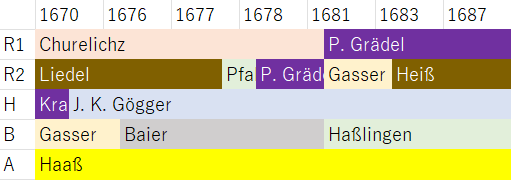
fig. 3a: Gasser was Bohemia, and come back as the Second Reichs
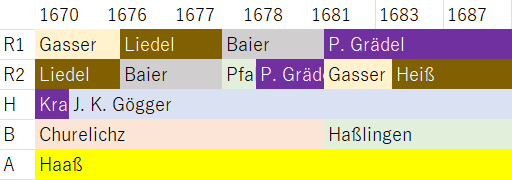
fig. 3b: Gasser was Reichs, and come back to Reichs again
Heralds' biography
Familysearch requires your account to access the materials.
Legend
See also Abkürzungsverzeichnis. (pdf.)
- AAK
- Adelsakt (StA)
- AVA
- Allgemeines Verwaltungsarchiv, Wien (StA)
- HKA
- Hofkammerarchiv, Wien
- StA
- Staatsarchiv, Wien
- *
- My decipher
Georg Gregor Beringer / Peringer von Ber[e]nberg / Pernberg
| Date | Event | Source | Remarks |
|---|
| 1588 | Was born in this year, assumed by his age at his death (see below). | | |
| 1624 | Incumbent as Bohemia. Presumably promoted to Hungary. | | |
| 1626 | Mentioned as ReichsEhrnhold. | | |
| 1627 | Presumably had promoted to Reichs as Parr (qv) was mentioned as ungarischer Herold in this year. | AT-OeStA/HHStA RHR Grat et Feud Laienherrenpfründen 2-97 Parr, Friedrich, ungarischer Herold, 1627 (Akt (Sammelakt, Grundzl., Konvolut, Dossier, File)) | |
| 1628 | Mentioned as Heraldum Imperialem. | | |
| 1653-4 | Mentioned as Reichs Herold (sole herald appeared in the Kayserl. Hoff-Stat). | | |
| 1660 | Incumbent as one of five heralds. Presumably the First Reichs as assumed by the fact he was mentioned at the top of the five,
by his petition, and by the fact he had served, by far, longer than other four heralds. | | |
| 1661-10-17 | Died on or shortly before this day, at the age of 73. Mentioned as Georg Peringer, Kaÿ: Reichs Herold *. | TBP,
MF 6, 1.4.1661-10.10.1663, A-Z fol. 71r, 1st entry of the day.
Referred to by TBPX, l. 15969. | |
Related material
VieCPro: Georg Peringer.
AT-OeStA/HHStA RHR Grat et Feud Laienherrenpfründen 2-100 Peringer, Georg, Gregor, Reichsherold, 1630 (Akt (Sammelakt, Grundzl., Konvolut, Dossier, File)).
AT-OeStA/FHKA SUS RA 277.31 Kaiserlicher Passierungsbefehl an den Hofkriegszahlamtsverwalter Peringer wegen der dem 1628 an die Pforte abgesendeten Orator Hans Ludwig Freiherr von Kuefstein gereichten Gelder und der von ihm nach Konstantinopel mitgenommenen Prasente im Werte von 19.244 fl., 1630.0.
AT-OeStA/AVA Adel RAA 312.24 Peringer, Georg Gregor, kaiserlicher Reichsehrenhold, Adelsstand, „von und zu Bernberg”, Wappenbesserung, exemptio (Befreiung von allen bürgerlichen Ämtern), Salva Guardia, kaiserlicher Hofdienertitel, 1630.07.18 (Akt (Sammelakt, Grundzl., Konvolut, Dossier, File)).
AT-OeStA/AVA Adel RAA 27.23 Beringer von und zu Bernberg, Georg Gregor, kaiserlicher Hofdiener und Reichsherold, Adelsbestätigung, Wappenbesserung, 1636.10.30 (Akt (Sammelakt, Grundzl., Konvolut, Dossier, File)).
Die Akten des Kaiserlichen Reichshofrats. Serie II. Antiqua Band 2: Karton 44-135. (pdf.) See p.60 no. 44-7 and p.545 no. 758-7.
Georg Beringer von Pernberg schreibt an Karl Eusebius von
Liechtenstein wie derzeit die Voraussetzungen zur
Erlangung von Sitz und Stimme im
Reichsfürstenrat sind. Neben einem
reichsunmittelbaren Territorium sollte ein
Anwärter den Kaiser auch ersuchen, dass dieser um Zustimmung bei den Kurfürsten wirbt. (15.01.1641)
Damit sich verschiedene wichtige Personen für die Aufnahme des Hauses Liechtenstein in den Reichsfurstenrat einsetzen, müssen ihnen entsprechende Geschenke gemacht werden.
In the pdf, there is Gehorsambster Gröger [Georg Gregor] Peringer von Bernberger, manu propria.
AT-OeStA/HHStA RHR Judicialia Antiqua 50-1 Heilbronn, Bürgerschaft contra Heilbronn, Bürgermeister und Rat; Innerstädtischer Streit um Kontributionen, Einquartierungen und Stadtverfassung, 1650-1655 (Akt (Sammelakt, Grundzl., Konvolut, Dossier, File)) (Peringer, Georg Gregor (Vollmacht, 1652 04 22, Ausf., fol. 698r)).
AT-OeStA/HHStA RHR Judicialia Antiqua 118-12 Hildesheim, Jesuitenkolleg und Fulda, Jesuitenkolleg contra Goslar, Stadt; Gesuch um ein strafbewährtes Zahlungsmandat wegen rückständiger Zinsen aus gestifteten Teilen einer 1617 von der Stadt Goslar ausgegebenen Anleihe über 10.000 Reichstaler, 1656-1 (Goslar: Peringer, Georg Gregor).
Peringer von Pernberg, Georg Gregor | Der Dreißigjährige Krieg in Selbstzeugnissen, Chroniken und Berichten.
Muhly, Velten [Valentin] | Der Dreißigjährige Krieg in Selbstzeugnissen, Chroniken und Berichten. Am 23.11.1640 schrieb Peringer von Pernberg an Wenzel Eusebius von Lobkowitz.
Österreich, Leopold Wilhelm Erzherzog von (I) | Der Dreißigjährige Krieg in Selbstzeugnissen, Chroniken und Berichten. Peringer von Pernberg, Mitglied der kaiserlichen Gesandtschaft auf dem Reichstag.
Beringer von Bernberg, Adam - Oberdeutsche Personendatenbank.
Buriánková, Michaela,
"Systémy pr´vních poradců hraběte Ferdinanda Johanna Verduga (1653?1672) a hraběte Františka Karla Swéerts-Sporcka (1739?1742)", 2013. (Academia.)
See p.50 n. 148, p.57.
Amandus Krautenhuber or Khreidenhuber or Kreydenhueber
| Date | Event | Source | Remarks |
|---|
| 1594 | Was born in this year, assumed by his age at his death (see below). | | |
| 1624 | Started his career as a Hof Fourier. | TBPX, l. 11654 (explicitly states ab 1624).
Not sure for the source. | |
| 1631 | Incumbent as a Hoffurier. | | |
| 1637-02-15 | Started his career as Reichs-Herold. |
TBPX, l. 11654 (explicitly states seit 1637-02-15).
The source is probably AVA, AAK: Kreidenhueber, Amand, 18. IX. 1637 (R), as mentioned in Quellenzitat. |
The compiler says his office was Reichs.
Did he, however, in reality, start his carrier with the most junior title?
Also, there is this occurrence in the same year:
AT-OeStA/AVA Adel RAA 232.67 Kreidenhueber, Adam, kaiserlicher Hoffourier, Adelsstand, Wappenbesserung mit zwei Helmen, Rotwachsfreiheit, Diensttitel, exemptio, Schutz und Schirm, Salva Guardia, 1637.09.18 (Akt (Sammelakt, Grundzl., Konvolut, Dossier, File)).
Adam can be mis-decipher of Amand? |
| 1653-4 | Incumbent as a Hoffourier. | | |
| 1657 | Incumbent as a herald. |
HZABX, l. 5763.
The source is probably HKA, HZAB 1658, 104, fol. 192r-v, as mentioned in Quellenzitat.
Or, HKA, HZAB 1658, 104, fol. 220r-v, as mentioned in l. 5764, Quellenzitat. | |
| 1660 | Incumbent as one of five heralds. | | |
| 1664 | Mentioned as Reichsherold. | AT-OeStA/AVA Adel RAA 233.30 Kreydenhueber, Amandus, Reichsherold und Hoffourier, Wappenbesserung im Adelsstand, 1664.03.06 (Akt (Sammelakt, Grundzl., Konvolut, Dossier, File)). | |
| 1666 | Incumbent as a Hoffourier. | Kunibert von Wentzelsberg, kaiserl. oberster Hofquartiermeister, und
die zwei ältesten Hoffouriere Amandus Kraidenhueber und
Jakob Lydl von Schwanau bestätigen Sigmund Friedrich Engl zu Wagrain, niederösterr... - Archivportal-D
Archivaliensignatur: Hochstift Freising Urkunden, BayHStA, Hochstift Freising Urkunden 2068
Laufzeit: 1666 Dezember 21 | |
| 1667 | Incumbent as a Hoffourier. | Kunibert von Wentzelsberg, kaiserl. oberster Hofquartiermeister, und
die zwei ältesten Hoffouriere Amandus Kraidenhueber und
Jakob Lydl von Schwanau bestätigen Sigmund Friedrich Engl zu Wagrain, kaiserl. und... - Archivportal-D
Archivaliensignatur: Hochstift Freising Urkunden, BayHStA, Hochstift Freising Urkunden 2069
Laufzeit: 1667 Februar 19
| |
| 1668 | Incumbent as a herald. |
HZABX, l. 5764.
The source is probably HKA, HZAB 1667/68, fol. 236r and/or 1669, fol. 153r, as mentioned in Quellenzitat. | |
| 1669 | Incumbent as a Hoffourier. | Rescher 2016, p.266, n.498.
The Kreidenhuber must be our herald. | |
| 1670-03-17 | Died on this day, at the age of 76. Mentioned as
Kaÿser : Heralt vnd A[l]tister Hofffvrier. | Confirmed by
TBP,
MF 9, 1.1.1670-28.12.1672 fol. 21v,
1st entry of the page:
Khaÿ Hof Fourier und Reichs Herold * (see f. 21r for the date).
Referred to by TBPX, l. 11654. |
See also Wien, seine Häuser, Menschen und Kultur, 2101.
D. 1683 as mentioned in Rescher 2016, p.443 (Kreidenhuber, Amandus) is impossible. |
| 1673 | Mentioned as a Hoffourier and a herald. | Monatsblatt der „Adler“, 3. Band, Nr. 154, Wien October 183, pp.205ff.,
Beim niederösterrr. Landmarschall'schen Gerichte hinterlegte Verträge,
derzeit im n. ö. Landesarchiv. Verträge über Heimsteuer, Widerlage und Ehecontracte, pp.205ff.,
p.207, under Rebenegg. |
Rebenegg, Edler von Rebeneg ... Ehevertrag mit Maria Elisabeth Kreidenhuber, Tochter nach dem kaiserl. Hof-Fourier und Herold Amand Kreidenhuber und seiner Gattin Elisabeth... a. 1673. Should be a retrospective mention. |
Related materials
VieCPro: Amandus Kreidenhuber
Hartmann-Franzenshuld, E. von,
"VI. Die Medaillen er österreichischen Behem", in
Numismatische Zeitschrift,
6. und 7. Band, 1874-5,
pp.142ff.,
p.143, n. 3. (Internet Archive.)
Renesse, Théodore de,
Dictionnaire des figures héraldiques,
Bruxelles: Société belge de librairie,
1903. (Internet Archive.)
In p.32, there is:
Lévrier issant et naissant -
armes écartes -
KREIDENHUEBER (s. 1 et 4).
[See his arms here.]
Lorenzo de Churelichz or Lorenz von Churelitz / Churlichtz
| Date | Event | Source | Remarks |
|---|
| 1621 | Was born in this year, assumed by his age at his death (see below). | | |
| 1654 | In service for war. | AT-OeStA/AVA Adel RAA 65.15 Churelich, Laurenz, in kaiserlichen Kriegsdiensten, aus Illyrien, rittermäßiger Adelsstand, Wappenbesserung, 1654.04.27 (Akt (Sammelakt, Grundzl., Konvolut, Dossier, File)). | |
| 1655 | Started his career as a Hofkammerdiener. | Körbl HKX, l. 189. | |
| 1658 | Incumbent as Bohemia. | |
He published this on this occasion: Churelichz,
Lorenzo de, Per la solennissima entrata in Vienna nel ritorno dalla Città Imperiale di Francofort Al sacratissimo ... Imperatore Leopoldo, 1658. |
| 1660 | Incumbent as one of five heralds. | | Also in the same book,
his name appears in the title page: Penes Heraldum Cas. Laurentium de Chureliz. |
| Summer - Autumn, 1660 | Performed the function of Austria herald. | | |
| 1663 | Styled himself S. C. Majestatis Heroaldí | Churelichz, Lorenzo de, Isagoge Genealogiaca... cum Armorum, et Arboris Genealogicae aeneis figuris, Wien: Typis Joannis Jacobi Kürner, 1663. (Google Books.) | |
| 1666 | Styled himself aroaldo di S. M. | Breve reguvaglio ... sopra l'ottomana ambasciata ... cioè di
30 maggio l'anno 1665, sino li 20 di marzo 1666,
de Lorenzo de Churelich, aroaldo di S. M.,
Hammer, Joseph von,
Geschichte des Osmanischen reiches, Band 6., Pest: C. A. Hartleben, 1830,
p.171, note b. (Google Books.) | |
| 1666-02-10 | Mentioned as Reichs Herold *. | TBP,
MF 7, 1.1.1664-31.12.1666 fol. 227r, 2nd entry of the day.
Referred to by TBPX, l. 3091. | |
| c. 1672 | Incumbent as a Hof-Cammer-Diener. | | |
| 1673 | Styled himself Sacri Romani Imperij Heroaldo. | "Genealogia Serenissimorum ac Potentissimorum Magnorum Moskoviae Ducum totiusque Russiae Invictissimorum Monarcharum Singulari Studio ac Diligentia ex diversis cum impressis tum manuscriptis Authoribus, alijsque fide dignissimis monumentis collecta, Laurentio de Churelichz sacra caesarea Regiaque Maiestatis Leopoldi I Consiliario et Sacri Romani Imperij Heroaldo. 1673"
mentioned in "РОДОСЛОВИЕ"
ЛАВРЕНТИЯ
ХУРЕЛИЧА; XI. 493. Papierhandschrift des XVII. Jahrh. 45 Blatter in 2o. | |
| 1674 | Mentioned (or styled himself) as SAC: CAES: MAIESTATIS CONSILIARIO, ET HEROALDO | | |
| 1675 | Mentioned as Imperii Fecialis. | A. 1675
... quo tempore Mosecorum
Principis Oratorem Consiliarius Cæsareus,
Imperii Fecialis & Com̃issarius, nobilis
Dominus à Chureliz, ... in
Schleder, Johann Georg,
Relationis Historicæ
Autumnalis Continuatio: M. Gothardo Arthusio Succenturiati:
Sive Rerum In Germania, Italia, Hispania, ..., tomi 40., liber 3., Frankfurt am Main: Johannis Goͤrlini, 1675,
Caput I.
Rerum in Aula LEOPLIDI Casaris Augusti gestarum, pp.3ff., p.4. (Google Books.) | |
| 1676 | Styled himself Romani Imperii Heraldo. | Tabula: authore Laurentio de Churelichz Aurata Militia Equite, et Comite Lateranensi, nec non Sac. Caes. Maj. Consiliario, et Romani Imperii Heraldo. Viennae Austriae Anno MDCLXXVI in
Генеалогия
светлейших
и могущественнейших
герцогов Курляндии и Семигаллии,
ведомая через браки императоров,
королей и верховных правителей,
от Карла Великого,
первого императора Германии,
а также родов других двадцати непобедимейших императоров;
с добавлением изображений и кратких описаний,
а также родословной таблицы предыдущих светлейших герцогов курляндских,
сочиненная Лаврентием Хуреличем, кавалером Ордена Золотой шпоры,
графом Священного Латеранского дворца,
а также советника Его императорского
величества и герольдмейстера Римской империи.
Вена, Австрия, 1676 г. - Churelichz, Laurentius de (XVII) | НЭБ Книжные памятники
| See also
XI. 493. Papierhandschrift des XVII. Jahrh. 45 Blätter in 2o.
Alter Eigenthümer Romanus Döll Prior von Wiblingen.
Genealogia Curlandiae et Semgalliae Ducum. ... Der Stammbaum ist ausgeführt
von Laurentius de Churelichz ... Reichsherold Viennae 1676. ...
Czerny, Albin, Die Handschriften der Stiftsbibliothek St. Florian,
Linz: Franz Ignza Ebenhöch (M. Quirein), 1871, p.172.
|
| 1679 | Appointed Spesierungskommissären für die zu erwartende moskowitische Gesandtschaft. | AT-OeStA/FHKA SUS RA 269.15 Bestellung des Laurentius von Churelich, des Jacob von Grüenfeld und des Wolf Christoph Haas zu Spesierungskommissären für die zu erwartende moskowitische Gesandtschaft, 1679 (Akt (Sammelakt, Grundzl., Konvolut, Dossier, File)) | |
| 1681-03-05 | Died on this day, at the age of 60. Mentioned as Reichs Herold *. | Obiit 5. Martii 1681
[Kurelić, Robert,
"Lovro Kurelić, Istranin na dvoru Leopolda I. Poliglot, carski herald i dvorjanin", in Histria, vol.14, 2024, pp.35-64, p.61. (pdf.)]
For his office and age see TBP,
MF 14, 7.10.1679-30.9.1681 fol. 249v, 2nd entry of the day.
Referred to by TBPX, l. 3091. | |
| 1681 | Buried at the Minoritenkirche. | 1681 Laurentius Churelitz [Salvadori, Giovanni,
Die Minoritenkirche und ihre älteste umgebung : ein beitrag zur geschichte Wiens,
Wien: Verlage der Congregation der Italienischen Nationalkirche, 1894Anhang. Begrabene, pp.357ff.,
p.372. (Internet Archive.)
In the same page there is also: 1670 Magdalena Churelichz and there is her Grabschrift in
Anhang. Grabschriften, pp.325ff.,
p.353. | |
Related material
VieCPro: Churelitsch, von, Lorenz
VieCPro: Chureliz , Lorenz.
AT-OeStA/FHKA SUS RA 308.19 Befehl an den Hofkriegszahlmeister, dem Hofkammerdiener Lorenz von Churelitz zur Verehrung für den aus Dänemark angekommenen tatarischen Gesandten Achmet Aga 200 Reichstaler auszufolgen, 1667.07.06 (Einzelstück (Aktenstück, Bild, Karte, Urkunde)).
AT-OeStA/FHKA SUS RA 309.3 Buchhaltereibericht betreffend das Partikulare des Lorenz von Churelitz (Churelich) über die Spesierug des Osman Aga, 1668 (Akt (Sammelakt, Grundzl., Konvolut, Dossier, File)).
CA 3.382 Mitteilung, dass Laurenz von Curelichtz zum landesfürstlichen Rat ernannt wurde, 1668.06.18 (Akt)
AT-OeStA/FHKA SUS RA 311.1.3 Buchhaltereibericht betreffend das Partikulare des Lorenz von Churelich über die Spesierung des in Raab angekommenen Hussain Aga, 1672.03.30 (Einzelstuck (Aktenstück, Bild, Karte, Urkunde)).
AT-OeStA/FHKA SUS RA 269.14 Passbrief für den Spesierungskommissar Laurentius von Churelich, der die moskowitische Gesandtschaft bis an die venetianische Grenze begleiten soll, 1673 (Akt (Sammelakt, Grundzl., Konvolut, Dossier, File)).
AT-OeSTA/HHStA HA OMaA 626-42 Testament des Laurenz Curelichz, Kammerdiener, 1677.10.28 (Akt (Sammelakt, Grundzl., Konvolut, Dossier, File)).
AT-OeStA/FHKA SUS RA 269.15 Bestellung des Laurentius von Churelich, des Jacob von Grüenfeld und des Wolf Christoph Haas zu Spesierungskommissären für die zu erwartende moskowitische Gesandtschaft, 1679 (Akt (Sammelakt, Grundzl., Konvolut, Dossier, File)).
Buchberger, Reinhard,
"Lebl Höschl von Wien und Ofen:
Kaufmann, Hofjude und Spion des Kaisers", in
Rauscher, Peter, Staudinger, Barbara, Hödl, Sabine (hrsg.),
Hofjuden und Landjuden: Jödisches Leben in der Frühen Neuzeit,
Berlin and Wien: Philo, 2004, pp.217ff., p.220.
Cevad Memduh Altar / AraŞtırma / DOĞU-BATI KÜLTÜR GEÇİŞLERİ ÜSTÜNE BİR DENEME.
Cobanoglu, Dominik,
"Die diplomatischen Beziehungen zwischen den Osmanen und
den Habsburgern im 17. Jahrhundert unter besonderer Berücksichtigung
der Großbotschaft von Graf Walter von Leslie im Jahre 1665 / 1666", BA thesis, Wien, 2017. (Academia.)
Cvetko, Dragotin,
"The Renaissance in Slovene Music", in
The Slavonic and East European Review,
Vol. 36, No. 86, 1957, pp. 27-36. See p.36 n. 25.
Hahn, Daniela,
"Zwei Besuche im österreichischen Litorale.
Triest als Station der innerösterreichischen Erbhuldigungsreisen Leopolds I. 1660 und Karls VI. 1728",
Mag. Phil. Wien 2013. (Academia.)
See p.1, n. 3, pp.6ff., p.52.
Hammer, Joseph von,
Geschichte des osmanischen Reiches: grossentheils aus bisher unbenützten Handschriften und Archiven,
6. Band, Pest: C. A. Hartleben, 1830.. (Internet Archive.)
See p.171 n. b.:
Auf der kaiserl. Hofbibl. unter den Handschriften hist. prof.
Nr. 485: Breve raguvaglio con la relatione sopra l'Ottomana Ambasciata,
come di tutti Ii successi, et attioni di quella dal primo giorno che giunse nelli stati e
provincie di S. M. C., cioé di 30 di Magggio l'anno 1665 sino li 20 di Marzo
1666 da Lorenzo de Churelich, Aroaldo di S. M.
Kaiserliche Akademie der Wissenschaften in Wien (hrsg.),
Tabvlae codicvm manv scriptorvm praeter graecos et orientales in Bibliotheca palatina Vindobonensi asservatorum,
Volumen V. Cod. 6501-9000, Wien Caroli Geroldi Filivs, 1871. (Internet Archive.)
In p.268, there is:
8565. [Hist. prof. 784.] ch. XVII. 65. 4o. c. imag. æri incisa imperat. Leopoldi
I. deaur. Laurentias de Churelichz, Breue Raguaglio con la
relazione sopra l'ottomana Ambasciata come di tutti li successi et
attioni di quella dal primo giorno, che giunse nelli stati e prouintie
di S. M. Cesarea, cioè li 30. di Maggio l'anno 1665 sino li 20. di
Marzo 1666.
Kokole, Metoda,
"Italijanske operne predstave pri Auerspergih sredi 17. stoletja - drobtinica k slovenskemu glasbenemu zgodovinopisju",
in Muzikološki zbornik, vol. 35, 1999.
Kokole, Metoda,
"Italian Operas In Ljubljana In the Seventeenth and Eighteenth Centuries", in Colzani, Alberto,
Dubowy, Norbert, Luppi, Andrea, Padoan, Maurizio,
Il teatro musicale italiano nel Sacro Romano Impero nei secoli XVII e XVIII, Como: A.M.I.S., 1999.
Kokole, Metoda,
"The Earliest Operas in Ljubljana: the “Comedia Italiana in Musica” (1660) and “Il Tamerlano” (1732)", in
M. Bucciarelli, Dubowy, N. Strohm., R. (eds.), Italian Opera in Central Europe, Berlin: Berliner wissenschaftlicher Verlag, 2006, pp. 51-66.
Noe, Alfred,
Geschichte der
italienischen Literatur
In Österreich,
Teil 1: Von den Anfängen bis 1797,
Wien, Köln and Weimar: Böhlau, 2011. (pdf.)
See p.205, 557.
Reiter, Clara,
"„ und anfangs zum k. k. Hofdollmetscher
ebendaselbst befördert “
Auf den Spuren der Hofdolmetscher in der
Habsburgermonarchie",
Mag. Phil. thesis, Graz, 2010.
Reiter, Clara,
"In Habsburgs sprachlichem Hofdienst.
Translation in den diplomatischen Beziehungen
zwischen den habsburgischen Höfen von Madrid und Wien
in der Frühen Neuzeit", Ph.D Thesis, Karl-Franzens-Universität, Graz, 2015.
Ritzer, Andreas,
"Die Sprache(n) der Diplomatie.
Lingue franche versus Mehrsprachigkeit und
Dolmetschen", Master's Thesis, Wien 2017. See p.69.
Schönfeld, Carlo Morelli di,
Della Bona, Giuseppe Domenico,
Istoria della Contea di Gorizia In quattro volumi compresavi un Appendice di note illustrative,
vol. 4, Gorizia: Paternolli, 1856,
Note ed Aggiunte all'Istoria, Capiloto quarto. Leopoldo riceve l'omaggio dela Contea di Gorizia
nell'anno 1660. Vol. II. pag. 63 e seguenti, pp.111ff. (Internet Archive.)
Struve, Burkhard Gotthelf, Buder, Christian Gottlieb,
Bibliotheca historica selecta: in svas classes distribvta, t. 2,
Jena: Svmpt. Christ. Henr. Cvnonis, 1740. (Google Books.) In
§. IX, pp.1054ff., p.1054, there is:
LAVRENTII de CHVRELICHZ narratio itineris
in Styriam, Carinthiam & Cariniolam Leopoldi I.
Viennæ 1661. 8.
(Here is t.1, 1740.)
See also Adelung, Johann Christoph,
Fortsetzung und Ergaͤnzungen zu Christian Gottlieb Jochers Allgemeinen Gelehrten-Lexico.
2. Band: C-J, Lepzig: Johann Friedrich Gleditschen, 1787, col. 327:
Churelichz, (Laurentius,) lebte in der letzten Haͤlfte
des vorigen Jahrhundertes, und schrieb :
Narrationem Itineris in Styriam, Carinthiam, et Carniolam Leopoldi 1. Wien, 1661. (Internet Archive.)
Schmitz, Carl, Historisch-topographisches Lexicon von Steyermark, Gratz: Andreas Kienreich, 1823,
p.XVIII says 1681, I believe this is an error.
Zaugg, Roberto,
"Joseph Furttenbach, Lebenslauff 1652-1664 [the diary of a seventeenth-century German engineer and collector]". (Academia.)
Seems to be an excerpt of
Greyerz, Kaspar von, Siebenhüner, Kim,
Zaugg, Roberto (hrsg.),
Joseph Furttenbach. Lebenslauff 1652?1664, Köln, Weimar and Wien: B&oouml;hlau: 2013.
Index says Cureliz, Lorenzo 170.
Johann Carl Öllmann auf Edelbrun
See the dedicated page:
Some thoughts regarding Öllmann heralds.
Johann Gasser or Gassner
| Date | Event | Source | Remarks |
|---|
| 1660 | Incumbent as one of five heralds. | | |
| 1665-04-28 | Mentioned as Reichsherold (need however verification what was the appellation in the original text is needed), and got a house through his wife's last will. |
Wien, seine Häuser, Menschen und Kultur, 2401. | |
| 1668 | Mentioned as Reichsherold und Hofkastner (need verification however). |
Schweickhardt, Friedrich Freiherr von,
Darstellung des Erzherzogthums Oesterreich unter der Ens, ...,
7. Band: Viertel untern Manhartsberg,
Wien: Gedruckt bei den PP. Mechitaristen, 1835,
Strebersdorf, pp.54ff.,
p.57.
| Archiv Wien - Strebersdorf (Marienheim) gives same information.
|
| 1675-04-03 | Mentioned as R: K: M: Reichs Herold *. | TBP,
MF 11, 1.1.1675-30.6.1676 fol. 28v,
1st entry of the page. Referred to by TBPX, l. 6025. | |
| 1679 | Mentioned as geweste hofcastner. |
Körbl, Hansdieter,
Einblick in die Finanzwirtschaft zur Zeit Leopolds I.
Berichte an den Kaiser über den Zustand seiner Länder im Jahr 1679,
Wien: Verlag der österreichischen Akademie der Wissenschaften, 2022,
Zur sechsten und siebenten Frage - Abrechnungreste von Beamten, Liste, pp.217ff, p.218; and
Beilage E - Unbeglichene Rechnungsreste, pp.241ff., p.242.
(I consulted the printed version.) |
See Der Bericht Johann Gabriel Selbs, pp.53ff, Zweite Klasse - Ämter ohne Überschuss, pp.106ff., p.116 also.
Index, p.272 says Gassner, Johann (1614-1683?), Hofkastner. Not sure how the author found year of his birth.
In the work, the only herald I could find is Gasser (who was however not styled as such). |
| 1683 | Was living in Wien, Nr. 154 or 375. Mentioned as Kay. Reichsheroldt (the spelling suggests the author kept that of the original text). | Camesina 1856, Verzeichniss der Namen der Besitzer von Häusern der inneren Stadt Wien in Jahre 1683, pp.LXIIff., p.LXVI, col. b,
referring Grundbücher, Sch. VIII p.261.
|
STRASSEN- UND HÄUSER-SCHEMA NACH DER NEUEN NUMBERIRUNG, pp.CXXIff.,
p.CXXI col. b says
154 alt 6 neu Renngasse. |
| 1683-01-05 | Bequeathed his house to his family members. |
Wien, seine Häuser, Menschen und Kultur, 2401. | |
| 1683-03-06 | Mentioned as Reichsherold (need verification however), and legal procedure to inherit his properties took place. |
AT-OeStA/HHStA HA OMaA 650-577 Verlassenschaftsabhandlung Gasser Johann, Reichsherold, Erbserklärung, 1683.03.06 (Akt (Sammelakt, Grundzl., Konvolut, Dossier, File)) | Judging from these last two occurrences, he must have died in early 1683, shortly before the siege. |
Related materials
Palais Schönborn-Batthyány. (German Wikipedia.)
Renngasse 4 – Wien Geschichte Wiki.
Jakob Lukas Liedel or Lidl or Lydl von Schwanau
| Date | Event | Source | Remarks |
|---|
| 1646 | Incumbent as a Hoffourier. | Mauer 2013, p.18. | |
| 1653-4 | Incumbent as a Hoff-Furier. | | |
| 1657-07-01 | Incumbent as a Hof-Fourier. | HZABX, l. 6261.
The source is probably HKA, HZAB 1658, 104, fol. 220v-221r as mentioned in Quellenzitat. | |
| 1662-01-01 | Incumbent as a Reichs-Herold. | HZABX, l. 6263.
The source is probably HKA, HZAB 1662, fol. 166r as mentioned in Quellenzitat.
Or, HKA, HZAB 1662, fol. 179v, as mentioned in l. 6261, Quellenzitat.
See also
Mauer 2013, p.18. | Must have succeeded Beringer who had died c. 17 Oct. 1661. |
| 1663 | Styled himself Reichs Herold. | Publication of Imperial Ban against the city of Erfurt.
| |
| 1666 | Incumbent as a Hoffourier. | Kunibert von Wentzelsberg, kaiserl. oberster Hofquartiermeister, und
die zwei ältesten Hoffouriere Amandus Kraidenhueber und
Jakob Lydl von Schwanau bestätigen Sigmund Friedrich Engl zu Wagrain, niederösterr... - Archivportal-D
Archivaliensignatur: Hochstift Freising Urkunden, BayHStA, Hochstift Freising Urkunden 2068
Laufzeit: 1666 Dezember 21 | |
| 1667 | Incumbent as a Hoffourier. | Kunibert von Wentzelsberg, kaiserl. oberster Hofquartiermeister, und
die zwei ältesten Hoffouriere Amandus Kraidenhueber und
Jakob Lydl von Schwanau bestätigen Sigmund Friedrich Engl zu Wagrain, kaiserl. und... - Archivportal-D
Archivaliensignatur: Hochstift Freising Urkunden, BayHStA, Hochstift Freising Urkunden 2069
Laufzeit: 1667 Februar 19
| |
| 1669 | Incumbent as a Hoffourier. | Rescher 2016, p.266, n.498.
The Lidl must be our herald. | |
| 1669-05-30 | Mentioned as Reichs ... [what is written there? it does not look like Herold, but
if the precedent word is Reichs, then what else can come? ] und Hoff Forier. * | TBP,
MF 8, 1.1.1667-31.12.1669 fol. 253r, 2nd entry of the day.
Referred to by TBPX, l. 12746. | |
| 1671-12-26 | Mentioned as Khaÿ Reichs Herold und Hoff Forier. * | TBP,
MF 9, 1.1.1670-28.12.1672 fol. 197r, 1st entry of the day.
Referred to by TBPX, l. 12746. | |
| 1672-09-28 | Mentioned as Rom Kaÿ Maÿ Reichs Herold und Hoff Forir. * | TBP,
MF 9, 1.1.1670-28.12.1672 fol. 283r, 1st entry of the day.
Referred to by TBPX, l. 12746. | |
| 1676-05-12 | Mentioned as Kay Reichs Herold, und ältister Hoff Fourier. * | TBP,
MF 11, 1.1.1675-30.6.1676 fol. 149v, 1st entry of the day.
Referred to by TBPX, l. 12746. | |
| 1677 | Incumbent as a Hoff Furier. (Herr Lidl must be him.) | | |
| 1677 | Died in this year. | Monatsblatt der „Adler“, 4. Band,
Nr. 214, Wien, October 1898, pp.333ff., "Einige genealogische Auszüge (Fortsetzung)", pp.333ff., p.334;
AT-OeSTA/HHStA HA OMaA 626-16 Testament des Jacob Lydl von Schwanau, Reichsherold und Hoffourier, 1677.03.25 (Akt (Sammelakt, Grundzl., Konvolut, Dossier, File)).
Rescher 2016, p.443 (Lidl von Schwanau, Jakob);
Mauer 2013, p.18 seems to be saying he was living (or dying) 1678.
| |
Related materials
VieCPro: Jacob Leidel.
AT-OeStA/FHKA SUS Fam.A. L-103 Lidl (Lydl) von Schwanaw, Christoph Jacob, Verehrung einer goldenen Kette im Wert von 195 Kronen, 19.06.1585 und 1650; Jacob, Reichsherold und Hoffourier, Verehrung einer goldenen Kette im Wert von 60 Kronen, 28.09.1671, 1585-1671 (Akt (Sammelakt, Grundzl., Konvolut,
Jacob, Reichsherold und Hoffourier, Verehrung einer goldenen Kette im Wert von 60 Kronen, 28.09.1671
AT-OeStA/HHStA RHR Judicialia APA 111-63 Lydl, Jakob; Anzeige der Stadt Erfurt wegen Majestätsbeleidigung; Bitte um Beteiligung an Strafzahlung, 1664 (Akt (Sammelakt, Grundzl., Konvolut, Dossier, File)).
AT-OeSTA/HHStA HA OMaA 636-64 Testament der Anna Rosina Lydlin von Schwanau, 1742.09.21 (Akt (Sammelakt, Grundzl., Konvolut, Dossier, File)).
AT-OeSTA/HHStA HA OMaA 638-51 Testament des Mathias Lydl von Schwanau, k.k. Hofkriegsrat, 1743.06.13 (Akt (Sammelakt, Grundzl., Konvolut, Dossier, File)).
Lydlsches Stiftungshaus - Wien Geschichte Wiki.
Pablo-Neruda-Hof - Wiener Wohnen - Gemeindewohnungen.
St. Johann Nepomuk Vienna - Johann Nepomuk Kirche.
Spielman, John Philip, The City & the Crown: Vienna and the Imperial Court, 1600-1740, Purdue University Press, 1993, p.225, n.50. The author says Lydl was a herald for 15 years and a Fourier for 31 year (what does the then mean?). However his statemet about von Schwanau is obviously erroneous. (Google Books.)
Wolff Christoph Haaß von Oetl or Adel or Aettel or Ädl or Äsl
| Date | Event | Source | Remarks |
|---|
| 1633 | Was born in this year, assumed by his age at his death (see below). | | |
| 1661 | Incumbent as Kommissär für Unterhalt der moscovitischen Gesandtschaft. | Reiter 2015, p.140. | |
| 1661-05-24 | Incumbent as Austria. | HZABX, l. 3702.
The source is probably HKA, HZAB 1660/61, 106, fol. 172v, as mentioned in Quellenzitat.
| Must have succeeded Öllmann who had died c. 24 Mar. 1661, while Beringer occupied his office a little bit longer until his death in Oct. in the same year. |
| 1666 | Incumbent as Austria. | TBPX, l. 7481. The source is uncertain. | Source is uncertain, yet it specifically states he was Austria. |
| 1667/68 | First mentioned as Hofkammerdiener. | Körbl HKX, l. 192. | |
| c. 1672 | Incumbent as a Hof-Cammer-Diener. | | |
| 1679 | Appointed Spesierungskommissären für die zu erwartende moskowitische Gesandtschaft. | AT-OeStA/FHKA SUS RA 269.15 Bestellung des Laurentius von Churelich, des Jacob von Grüenfeld und des Wolf Christoph Haas zu Spesierungskommissären für die zu erwartende moskowitische Gesandtschaft, 1679 (Akt (Sammelakt, Grundzl., Konvolut, Dossier, File)) | |
| 1680-04-30 | Wolf Christoph Haas von Oetl made a donation of 80 fl. for a regular ecclesiastical service. | QGSW,
1. Abt., 5. B., Doc. 6248,
p.388 col. b., |
In the same volume, There is one certain
Susanna Elisabeth Haassin geborne
Schwäbin, 8 Nov. 1668, Doc. 6160, p.329 col. a-b.
Further also thre is Susanna Elisabeth Haasin von Oetl
geborne Schwäbin, 12 Feb. 1692, in
1. Abt., 6. B., Doc. 6358,
p.19, cols. a-b.
|
| 1683 | Mentioned as Kayserl. Reichs-Herolden und Hoff-Cammer-Diener. | |
By this time he must have been the most senior herald in terms of career.
Camesina 1856, p.39 states
he was Adolf Christoph Haas, citing same Hocke and Vaelckeren, p.52. This must be an error.
|
| 1687-12-09 | Incumbent as Austria. | | |
| 1690-02-24 | Incumbent as Austria. | | Here ignoring Joseph I's (?) officers in the
same year. |
| 1692 | Incumbent as Austria. | TBPX, l. 7481. The source is uncertain. | Source is uncertain, yet it specifically states he was Austria. |
| 1692-01-30 | Mentioned as Kaÿ Hoffkam̃er Diener *. | TBP,
MF 17, 14.8.1688-30.11.1692 fol. 324v,
4th entry of the page.
Referred to by TBPX, l. 7481. | Why was he not mentioned as a herald...?
It is nevertheless obvious he then occupied his Austrian office. |
| 1702 | Incumbent as a Hof-Cammer-Diener. | | |
| 1704 | Last (and first) mentioned in the Yearbook as incumbent as Austria,
also mentioned as a Hof-Cammer-Diener. | | |
| 1705-04-17 | Died on or shortly before this day, at the age of 72. Mentioned as Kaͤyserl.
Rath / N. Oe. Herold und Spesirungs
Commissarius. |
Wienerisches Diarium,
Num. 178, 18. April 1705,
p.10 col. b. See also
TBP,
MF 21, 1.2.1705-31.1.1708 fol. 31v,
2nd entry of the page:
Röm Kaÿ Maÿ Rath, N: Ö: Herold * .
Referred to by TBPX, l. 7481. See further also
AT-OeSTA/HHStA HA OMaA 628-48 Testament des Wolf Christoph Haas von Ädl, 1705.04.04 (Akt (Sammelakt, Grundzl., Konvolut, Dossier, File)). |
N: Ö: Herold is curious. There are, however,
1705 and 1712
Erb-Huldigungen during which O'Kelly was mentioned as Nieder Österreichischer Herald (for both occurrences,
theoretically it is possible there were two heralds — Ö and NÖ —, but was it really so?
the narrative never explicitly mentioned like die beide Herolde). |
Related materials
VieCPro: Wolf Christoph Haaß
VieCPro: Wolf Christoph Haaß von Aettel
VieCPro: Christoph Haas
AT-OeStA/FHKA SUS RA 310.5 Aktenstücke betreffend die Spesierung des vom Wesir zu Ofen anhergesendeten Omar Chiaus durch den Hofkammerdiener Wolf Christoph Haas, 1670 (Akt (Sammelakt, Grundzl., Konvolut, Dossier, File)).
AT-OeStA/FHKA SUS RA 311.1.17 Passierungsbefehl an das Hofkriegszahlamt für den Hofkammerdiener Wolf Christoph Haas verrechneten Betrag für die im Februar 1674 übernommene Spesierung des Hassan Aga mit zwei Chiausen, 72 Personen und 80 Pferden, 1674 (Akt (Sammelakt, Grundzl., Konvolut, Dossier, Fi.
AT-OeStA/FHKA SUS RA 278.51 Passbrief für die in Salankement (Slankamen?) zu empfangende und durch die Spesierungskommissäre Reichsherold Wolf Christoph Haas von Aettel und Johann Andre von Harenne nach Wien zu geleitende türkische Gesandtschaft von 300 Personen, 1699.08.28 (Einzelstück (Aktenstüc.
Weinzettl, Walter,
"Hietzing. Seine siedlungs- und sozialgeschichtliche Entwicklung bis 1820", in
Jahrbuch des Vereines für Geschichte der Stadt Wien, Band 10, 1952-3, Die Herkunft und soziale Stellung der Besitzer, n.22. Mention to his name as Wolfgang Christoph Haas von Äsl.
Paul Grädel or Grädl von Ehrenthal
| 1629 | Was born in this year, assumed by his age at his death (see below). | | |
| 1661-04-01 | Incumbent as a Hof-Fourier. | HZABX, l. 3402.
The source is probably HKA, HZAB 1660/61, 106, fol. 188r, as mentioned in Quellenzitat. | |
| 1667 | Was living in Wien, Bäckerstrasse, Nr. 6 (alt Nr. 765). Mentioned as Hoffourier. | Wien, seine Häuser, Menschen und Kultur, 4202. | |
| 1673-08-22 | Paul Grädl haus in der obern
peckenstraße mentioned. | QGSW,
1. Abt., 6. B., Doc. 10850, p.274 col. b,
| Personenregister,
p.416 col. b mentions
documents 11229 (p.288 col. a, 1690, Juni 10) and
11268 (p.289 col. b, 1691, September 5) along with this 10850.
In the latter two occurrences, however, both mentions Grädl haus am Hof, no mention to his first name.
In 1709, his son died at the same house. In the 1690s, who was living there?
|
| 1677 | Incumbent as a Hoff Furier. (Herr Grädl must be him.) | | |
| 1678, after c. 06-02 | Seems to have been appointed a herald on Pfaller's death. |
Mauer 2013, p.18 n. 90. TBPX, l. 6781. also says
he was Herold, Reichs- (ab mind. 1678-11-00). Although for the latter of which I am not sure for the source,
still the date is consistent with Pfaller's date of death.
| |
| 1678-07-03 | Mentioned as Kaÿ: Hof Fourier *. | TBP,
MF 12, 1.1.1678-19.8.1679 fol. 49v,
1st entry of the day. Referred to by TBPX, l. 6781. | |
| 1678-09-02 | Mentioined as Kay Hof Fourier *. | TBP,
MF 12, 1.1.1678-19.8.1679 fol. 70v,
1st entry of the day. Referred to by TBPX, l. 6781. | |
| 1683 | Was living in Wien, Nr. 765 or 787
(p.LXIII: Die am Anfange stehenden Ziffern bezeichnen die Hausnummer von 1822. Die in der zweiten Reihe jene der Numerirung vom Jahre 1771 – 5).
Mentioned as Hoff-Forir.
| Camesina 1856, Verzeichniss der Namen der Besitzer von Häusern der inneren Stadt Wien in Jahre 1683, pp.LXIIff.,
p.CII, col. b. |
STRASSEN- UND HÄUSER-SCHEMA NACH DER NEUEN NUMBERIRUNG, pp.CXXIff.,
p.CXXIV, col. c, says 765 alt 12 neu Bäckerstrasse. See above, 1667 also. |
| 1683-09-30 | Incumbent as a Hof-Fourier. | HZABX, l. 3402.
The source is probably HKA, HZAB 1683, fol. 179r, as mentioned in Quellenzitat.
| It seems he left his Hof Fourier office c. 1683-4. |
| 1684 | Was living in Wien, Nr. 765 or 811
((n.p.) p.12?: Die erste Nummer bei den einzelnen Häusern bedeutet immer die jetzige
Nummer, die römische Ziffer I. bedeutet die erste Nummerirung von 1775,
die römische Ziffer II. die zweite Nummerirung 1795).
Mentioned as Hoffourier. |
Schimmer 1849,
p.145.
| |
| 1687-12-09 | Incumbent as the First Reichs. | | |
| 1690-02-24 | Incumbent as the First Reichs. | | Here ignoring Joseph I's (?) officers in the
same year. |
| 1697-04-11 | Mentioned as Kay: Herold *. | TBP,
MF 18, 1.12.1692-31.12.1697 fol. 362r,
Referred to by TBPX, l. 6781. | |
| 1701 | Was living in Becken-Straß. Mentioned as Kayserl. Reichs
Herold. |
Jordan, Johann,
Schatz, Schutz und Schantz deß Ertz-Hertzogtumbs Oesterreich : das ist
ein sehr genaue und ordentliche Beschreibung aller Gassen, Plaͤtz, Pallaͤst, Haͤuser,
Wien: gedruckt bey Johann van Ghelen, 1701,
Fordere Becken-Straß linckerseits fort, pp.10ff.,
p.11.
| Schimmer 1849,
Nachträge und Berichtungen, (n.p.) p.328?ff.
p.356, note to p.145, Nr. 765 says
Paul Gradl, Kayserl. Reichs-Herold was still living there in 1700. The author cited Schatz, Schutz und Schantz?
If it is the case, why 1700? |
| 1701-04-03 | Died on or shortly before this day, at the age of 72. Mentioned as
Kaÿ: Reichs Herold *. |
TBP,
MF 20, 1.1.1701-31.1.1705 fol. 16r,
1st entry of the day. Referred to by TBPX, l. 6781. | |
Related materials
VieCPro: Grädl , Paul
VieCPro: NN Grädl
AT-OeStA/AVA Adel RAA 151.22 Grädl, Erhard, kaiserlicher Reichshofkanzleischreiber, Paul, Brüder, rittermäßiger Adelsstand, „von Ehrentha“, Wappenbesserung, Rotwachsfreiheit, 1641.01.13 (Akt (Sammelakt, Grundzl., Konvolut, Dossier, File)) These are totally different arms, then another person?: AT-OeStA/AVA Adel RAA 151.21 Grädl, Erhard, Wappen, 1629.01.19 (Akt (Sammelakt, Grundzl., Konvolut, Dossier, File)).
AT-OeStA/AVA Adel HAA AR 305.41 Grädl von Ehrenthal, Johann Paul, rittermäßiger Adelsstand und Landmannschaft, 1641.01.13 (Akt (Sammelakt, Grundzl., Konvolut, Dossier, File)).
AT-OeStA/HHStA RHR RK VerfA Testamente 88-2 Grädl, Erhard, Reichshofkanzlist. Testament de publicando, 1671.11.09 (Akt (Sammelakt, Grundzl., Konvolut, Dossier, File)).
Rescher 2016, p.444 (Grädl von Ehrenthal, Paul).
Schachinger, Anton,
"Der Türkeneinfall von 1683 in Maria Enzersdorf und seine Auswirkungen", in
Jahrbuch für Landeskunde von Niederösterreich, B. 36, H. 1, pp.463-90. (pdf.)
In p.467 there is Paul Grädl v. Ehrental
u. seine Frau Eva Rosarina, was this the herald...? Alss in p.473, there is a mention to Johann Paul.
Bundesdenkmalamt,
"Das Schlösschen auf der Weide. Formenreichtum durch Barock und Rokoko", Wieder hergestellt,
B. 66., 2021. (pdf.) In, p.4: Als Bauherr kann Johann Paul Grädl von Ehrenthal angenommen werden, ...
Watzl, P. Florian,
Die Cistercienser von Heiligenkreuz, Graz, In Commission der Verlagsburchhandlung &bsquo;Styria‘, 1898. (pdf.)
In p.166 and p.178, there are menitons to his (possible) relatives, Bernhard and Friedrich.
Matthias Paul Grädel or Gradl von Ehrenthal
| Date | Event | Source | Remarks |
|---|
| 1669 | Was born in this year, assumed by his age at his death (see below). | | |
| 1701 | Possibly succeeded his father as a Reichs (presumably as the Second). | | Seems to have been never a Hof Fourier. |
| 1704 | Incumbent as the First Reichs. | | |
| 1705 | Acquired his father's house at Nr. 765 through inheritance. | Wien, seine Häuser, Menschen und Kultur, 4202. | |
| 1706 | Last mentioned in the Yearbook as incumbent as the First Reichs. | | |
| 1709-06-03 | Died on or shortly before this day, at the age of 40. Mentioned as
Kays. Reichs-Herold. | | |
Related material
VieCPro: Matthias Paul Grädl von Ehrenthal
Who is this? Wienerisches Diarium,
Num, 169, 18 Marz 1705,
p.8 col. b:
Abreiß deren hohen unde niedrigen Stands-Personen. ... Den 16. dito. Herr Paul Graͤdl / ins Reich.
Johann Kollman Gögger von Löwenegg or Collman Zoͤckherr
| Date | Event | Source | Remarks |
|---|
| 1635 | Was born in this year, assumed by his age at his death (see below). | | |
| 1661-04-01 | Incumbent as a Hof-Fourier. | HZABX, l. 3263.
The source is probably HKA, HZAB 1660/61, 106, fol. 187v, as mentioned in Quellenzitat. | |
| 1664 | Incumbent as a Hoffourier. | AT-OeStA/AVA Adel RAA 146.25 Gögger, Koloman, kaiserlicher Hoffourier, Johann, Brüder, rittermäßiger Adelsstand, „von Löwenegg”, Bewilligung Landgüter zu besitzen, 1664.02.23 (Akt (Sammelakt, Grundzl., Konvolut, Dossier, File)). | |
| 1667-12-09 | Mentioned as Khaÿ Hoff Fourir *. | TBP,
MF 8, 1.1.1667-31.12.1669 fol. 105v,
3rd entry of the day. Referred to by TBPX, l. 6561. | |
| 1668-12-24/25 | Mentioned as Kaÿ: Hof Fourir *. | TBP,
MF 8, 1.1.1667-31.12.1669 fol. 207v,
5th entry of the day. Referred to by TBPX, l. 6561. | |
| 1676-01-04 | Mentioned as Käy: Reichs Herold *. | TBP,
MF 11 1.1.1675-30.6.1676 fol. 105v,
2nd entry of the page. Not explicility referred to by TBPX, l. 6561 (not in the Quellenzitat,
but Verwandte and Funktion must have referred to this). | |
| 1676-02-12 | Mentioned as R. K. M: Reichs Herold *. | TBP,
MF 11 1.1.1675-30.6.1676 fol. 115v,
1st entry of the day. Not explicility referred to by TBPX, l. 6561 (not in the Quellenzitat,
but Verwandte and Funktion must have referred to this). |
Note that on 14 Apr. same year Baier was mentioned as Reichs Herold
which here brings a conflict, as there was no other seat for them:
Liedel, Churelichz, Gasser, Haaß
were the then other four officers.
The only theoretically possible option is (putting aside adding the 6th seat), his tenure as a herald occurred twice, one 1670-6, the other 1683-9. |
| 1677 | Incumbent as a Hoff Furier. (Herr Collmann must be him.) | | |
| 1684 | Mentioned as Reichsherold. | CA 3.1845 Mitteilung, dass Kollmann Gögger von Löwenegg zum kaiserlichen Rat ernannt wurde, 1684.02.24 (Akt):
der Reichsherold und Hofquartiermeister Kollmann Gögger von Löwenegg (Lewenegg). | |
| 1684-04-01 | Incumbent as Hof-Quartiermeister. | HZABX, l. 3263.
The source is probably HKA, HZAB 1684, fol. 158v, as mentioned in Quellenzitat.
Or, HKA, HZAB 1684, fol. 158r, as mentioned in l. 3271, Quellenzitat. | |
| 1685 | Incumbent as a Reichs-Herold. | HZABX, l. 3267.
The source is probably HKA, HZAB 1685-1, fol. 180v, as mentioned in Quellenzitat.
Or, HKA, HZAB 1685-1, fol. 129v or 1685-2, fol. 148r-v, as mentioned in l. 3271, Quellenzitat.
| Was his second (?) tenure just to secure an office for his son? (In 1685, the latter was too young to be appointed to any office.) |
| 1687-05-31 | Mentioned as Kaÿ: Raht und Obrister Hoff Quartir Maister *. | TBP,
MF 16, 23.8.1684-13.8.1688 fol. 280r,
1st entry of the day. Referred to by TBPX, l. 6561. | |
| 1687-12-09 | Incumbent as Hungary. | | The date is that of Coronation.
Did the Colomanus Guger in the 1687 decree mean him? |
| 1688 | Incumbent as a Reichs-Herold. | HZABX, l. 3267.
The source is probably HKA, HZAB 1688, fol. 280r-v.
Or, HKA, HZAB 1688, fol. 202v or 1689, fol. 135r, as mentioned in l. 3271, Quellenzitat. | |
| 1689 | Seems to have left his Hungarian office in favor of his son. |
Mauer 2013, p.18 n. 90.
| |
| 1690 | No more incumbent in any heraldic office in neither of the two events,
coronation and entrance. | | |
| 1693-01-29 | Mentioned as Iro Rom: Kaÿ: Maÿ: Raht und Obrister Hoff Quartiermeister *. | TBP,
MF 18, 1.12.1692-31.12.1697 fol. 15r ,
1st entry of the day. Referred to by TBPX, l. 6561. | |
| 1693-05-11 | Mentioned as Kaÿ: Raht, und Obrister Hoff Quartirmeister *. | TBP,
1.12.1692-31.12.1697 fol. 41r,
1st entry of the day. Referred to by TBPX, l. 6561. | |
| 1699 | Incumbent as Obrist-Hoff-Quartier-Meister. | | |
| 1700 | Incumbent as Obrister Hof-Quartier-Meister. | | |
| 1702 | Incumbent as Obrist Quartiermeister. | |
Mentioned as incumbent as such in subsequent years. |
| 1714-09-12 | Died on or shortly before this day, at the age of 79.
Mentioned as Obrist-Hof-Quartiermaister. | | Consistent with
Rescher 2016, p.441 (Löwenegg von Gögger, Koloman) (vor 1.4.1714 is a little bit earlier)
and
AT-OeSTA/HHStA HA OMaA 629-35 Testament des Colman Gügger von Löwenegg, Obersthofquartiermeister, 1714.08.06 (Akt (Sammelakt, Grundzl., Konvolut, Dossier, File)).
Among his heirs and heiresses was Johann Bernhard who must be the Hungarian herald.
Monatsblatt der „Adler“,
4. Band,
Nr. 216, Wien, December 1898, pp.353ff.,
"Einige genealogische Auszüge (Fortsetzung)", pp.357ff.,
p.359.
|
Related materials
VieCPro: Johann Kollman Gogger von Löwenegg
VieCPro: Bernhard Gögger Despite the first name, this should be Johann Kollman.
VieCPro: Colman Gögger von Löwenegg
AT-OeStA/HHStA HA OMaA 1-28a Dekret an den Hoffourier Colman Gögger wegen Dienstvernachlassigung, 1680.02.27 (Einzelstück (Aktenstück, Bild, Karte, Urkunde)).
AT-OeStA/HHStA HA OMaA 1-31 Beschwerde der sechs Hoffouriere uber den Hofquartiermeister Johann Gögger von Levenegg wegen Einbehalt der ihnen gebührenden Anteile der Hofquartierregalien, 1684 (Akt (Sammelakt, Grundzl., Konvolut, Dossier, File)).
AT-OeStA/AVA Adel RAA 146.26 Gögger von Löwenegg (Lebenegg), Coloman, kaiserlicher Rat und Hofquartiermeister, Alter Ritterstand als „Gögger Edler von Löwenegg, Ritter”, Wappenbesserung, 1689.12.31 (Akt (Sammelakt, Grundzl., Konvolut, Dossier, File)).
Profánní mapa Lewenegg
Král von Dobrá Voda, Adalbert, Ritter,
Der adel von Böhmens, Mährens und Schlesiens:
genealogisch-heraldisches Repertorium samtlicher Standeserhebungen,
Prädicate, Beförderungen, Incolats-Erteilungen, Wappen und Wappenverbesserungen des
gesamten Adels der Bohmischen Krone mit Quellen und Wappen-Nachweisen,
Prag: I. Taussig, 1904,
p.70 col. b. (Internet Archive)
Schönfeld, Ignaz von (hrsg.),
Adelsschematismus des österreichischen Kaiserstaates, 1. Jahrgang,
Wien: Carl Schamburg, 1824,
Ahnen-Buch pp.197ff.,
p.202. (Internet Archive.)
Franz Anton Freyherr von Buol.
. . .
Kollomann Gögger von Löweneck.
. . .
Maria Lucia Cath. Gögger von Löweneck.
Johann Bernhard Gögger von Löwenegg
| Date | Event | Source | Remarks |
|---|
| 1669 | Was born in this year, assumed by his age at his death (see below). | | |
| 1689 | Seems to have succeeded his father as Hungary. | See the father's entry. |
Consistent with HZABX, l. 3268, stating he was a Reichs Herold 1689-07-01.
The source is uncertain, maybe HKA, HZAB 1689, fol. 135r, mentioned in l. 3271, Quellenzitat (this line confuses him and his father).
It is unusual that he was made a herald at the age of c. 20.
However, his (supposed) father's death place (see his obituary) and
the house where the Johann Bernhard who died in 1756 lived in 1719 and subsequent years
are identical, there is, then, few doubt the herald and the Hof-Kriegs-Rat are same person. (The latter was Colloman's son, that's why
he lived in that house.)
It is probably because of this anomaly, [d]er Hoffourier Johann Christian Wilhelm beschwerte sich on this appointment,
as reported by Mauer 2013, p.18 n. 90.
Also it should be noted that, yes he was a son of a Hof Fourier, but the son himself was never a Hof Fourier. |
| 1690-01-19 | Incumbent as Second Reichs and mentioned as
Ritter deß
goldenen Sporens. | | This is again kind of irregularity —
he must have been the youngest of the 5 heralds present at the ceremony (again, if he was born in 1669). |
| 1690-02-24 | Incumbent as Hungary. | | |
| 1704 | Incumbent as Hungary and mentioned as deß H. R. R. Ritter. | | Regularly mentioned as such till 1729. |
| 1714 | Mentioned as Kriegssekretär. |
AT-OeStA/FHKA SUS Fam.A. G-65 Göger, Edler von Lewenegg, Johann Bernhard, Kriegssekretär, kaiserlicher[ ]Ratstitel, 1714.11.30 (Akt (Sammelakt, Grundzl., Konvolut, Dossier, File)) | |
| 1719 | Mentioned as Amts-Secretarien at the
General-Kriegs-Commissariat-Amt. | | Regularly mentioned as such in subsequent years and, in 1729, he got promoted (see below).
And, from 1722, among his colleagues, there is one Hr. Ignaz von Loͤwenegg who was a Concipist and in this year (I did not transcribed his entry),
log. im Stampfischen Hauß / untern Tuchlaͤden.
The latter promoted to Amts-Secretär in 1729 and last mentioned in 1737. |
| 1729 | Last mentioned in the Yearbook (till 1740) as incumbent as Hungary. | | Between 1731-39, the Hungarian office was vacant.
Promotion at the Kriegsrat forced him to retire? However, there was no appointee to fill the vacancy
till he came back to the same office after more than 10 years. Then, if there was such few (or in fact, no) task was demanded for the position,
why did he not just keep it...? It would not hinder him to perform his duty at the Kriegsrat.
|
| Incumbent as wirklicher Hof-Kriegs-Raht. | | Regularly mentioned as such down to 1746 (see below). |
| 1740 | Again incumbent as Hungary. | | |
| 1741 | Incumbent as Hungary. | VieCPro: Bernhard Gögger von Löwenegg.
The source is probably ÖSTA HHStA HA OMeA Protokolle 17 Protokoll in Hofparteiensachen (1741-1744)., fol. 16v, 69v as mentioned in
Quellen und Referenzen. |
Note that, in this year, there was another incumbent mentioned elsewhere. (Bernhard's old age possibly did not allow him to attend the coronation.) |
| 1746 | Last mentioned as Incumbent as Hof-Kriegs-Rath. | | In the next Yeabook,
1747 (p.116),
I could not find his name. I also tried to find it in that of 1756 (p.133), the year he died, which failed in vain.
|
| 1756-12-14 | Died on this day, at the age of 87. Mentioned as K. K. wuͤrkl. Hof-kriegs-raht. |
Kirnbauer von Erzstätt, Johann Evangelist,
J. Siebmacher's grosses und allgemeines Wappenbuch, 4. Band, 4. Abt., 1. Teil (Der Niederösterreichische Landstandische Adel (A – R)),
Nürnberg: Bauer und Raspe (E. Küster), 1909,
p.278 col. b. - p.279 col. a.,
here p.279:
Von Johann Bernhard v. L., Hofkriegsrath, der
14.12.1756 gleichfalls zu Wien gestorben, ...
and his obituary. | |
Related materials
VieCPro: Hans Bernhard Gögger
AT-OeStA/HHStA OMeA ÄZA 25-5 Vorsichtsmaßregeln zur Verhütung der Einschleppung der Pest in die Hofburg, besonders über die Verschließung der Burgtore, 1713.08.21-1713.09.10 (Akt (Sammelakt, Grundzl., Konvolut, Dossier, File)).
Bernand Goyger von Löwenegg
Paul Heinrich Pfaller
| Date | Event | Source | Remarks |
|---|
| 1636 | Was born in this year, assumed by his age at his death (see below). | | |
| 1667-06-01 | Incumbent as a Hof-Fourier. | HZABX, l. 83622.
The source is probably HKA, HZAB HKA, HZAB 1667/68, fol. 236v, as mentioned in Quellenzitat. |
In HZABX, Quellenzitat says he (as Hof-Fourier) occurred in 1669, 70, 1, 2, 3, 4, 5, 6, and 7. |
| 1677 | Probably incumbent as a Hoff Furier. (Herr Paul was possibly him.) | | |
| 1678-06-02 | Died on or shortly before this day, at the age of 42. Mentioned as
Reichs Herold und Käy: (?) Hoff Fourrier *.
| TBP,
MF 12, 1.1.1678-19.8.1679 fol. 40v,
1st entry of the day. Referred to by TBPX, l. 16128.
| Consistent with
AT-OeStA/HHStA HA OMaA 649-464 Verlassenschaftsabhandlung Pfaller Paul Heinrich, Hoffourier, Inventar, 1678.06.14 (Akt (Sammelakt, Grundzl., Konvolut, Dossier, File)). |
Related materials
VieCPro: Paul Heinrich Pfahler
Rescher 2016, p.444 (Pfaller/Pfull von Pfallershoven, Paul Heinrich).
Johann Conrad Baier or Peÿer von Egg
| Date | Event | Source | Remarks |
|---|
| 1670-04-21 | Incumbent as a Hof-Fourier. | HZABX, l. 439.
The source is probably HKA, HZAB 1670, 114 [Bd. 2], fol. 143r, as mentioned in Quellenzitat.
TBPX, l. 819 also gives same information. | |
| 1676-04-14 | Mentioned as Kaÿ Reichs Herold und Hoff Fourir *. | TBP,
MF 11, 1.1.1675-30.6.1676 fol. 137v, 1st entry of the day.
Referred to by TBPX, l. 819. |
Note that on 4 Jan. and 12 Feb. same year, Johann Kollman Gögger was mentioned as Reichs Herold. |
| 1677 | Probably incumbent as a Hoff Furier. (Herr Conrad was possibly him.) | | |
| 1680-12-31 | Living and must have occupied Hoffourier office. | HZABX, l. 439.
The source is probably HKA, HZAB 1680, fol. 145v, as mentioned in Quellenzitat. | Note that this does not guarantee he then concurrently held his heraldic office.
It is always possible he had resigned, same as Heiß. |
| 1681-03-01 | Died before this date. | HZABX, l. 439.
The source is probably HKA, HZAB 1681, fol. 154v, as mentioned in Quellenzitat. |
TBPX, l. 819 says
he died before 1686-11-29. I believe, here HZABX is reliable. |
Related material
VieCPro: Johann Conrad Baier
VieCPro: NN Conrad
AT-OeStA/AVA Adel RAA 314.57 Peyer, Johann Konrad, kaiserlicher Hoffourier, rittermäßiger Adelsstand für das Reich und die Erblande, „von Peyeregg”, privilegium denominandi, Lehenberechtigung, 1670.08.27 (Akt (Sammelakt, Grundzl., Konvolut, Dossier, File)).
AT-OeStA/HHStA OMeA ÄZA 6-37-2 Erteilung einer Expektanz auf die Stelle eines Hoffouriers an Conrad Peyer, 1662.12.24 (Akt (Sammelakt, Grundzl., Konvolut, Dossier, File)).
Rescher 2016, p.444 (Peyer (von Beyeregg), Hans Konrad).
Paul Heiß or Heyß
| Date | Event | Source | Remarks |
|---|
| 1640 | Was born in this year, assumed by his age at his death (see below). | | |
| 1677-08-01 | Incumbent as a Hof-Fourier. | HZABX, l. 4148.
The source is probably HKA, HZAB 1678, 122, fol. 154r, as mentioned in Quellenzitat. |
He was regularly mentioned as a Hof-Fourier in HZABX, l. 4148 down to 1702. |
| 1683-03-01 | Incumbent as a herald. | HZABX, l. 4148.
The source is probably HKA, HZAB 1683, fol. 179v or 1684, fol. 158v, as mentioned in Quellenzitat. | |
| 1687-12-09 | Incumbent as the Second Reichs. | | |
| 1689 | Incumbent as a Hof-Fourier. | |
Note that he was one of the two Hof-Fourier whose name was specifically mentioned. The other being Johann Goͤrtz.
|
| 1690-01-19 | Incumbent as the First Reichs. | | Temporarily?
The Second Reichs was Johann Bernhard Gögger. |
| 1690-02-24 | Incumbent as the Second Reichs. | | |
| 1692-06-30 | Incumbent as a herald. | HZABX, l. 4155.
The source is probably HKA, HZAB 1692, 137, fol. 198r or 1693, 138, fol. 192r, as mentioned in Quellenzitat. | |
| 1702 | Incumbent as a Hof-Fourier. | | |
| 1702-10-11 | Died on or shortly before this day, at the age of 62. Mentioned as Kaÿ: Hoff Fourir *. |
TBP,
MF 20, 1.1.1701-31.1.1705 fol. 141v,
3rd entry of the day. Referred to by TBPX, l. 8371. | |
Related materials
VieCPro: Paul Heiß
Rescher 2016, p.445 (Heiß, Paul).
Lorentz Ferdinand Haaßlinger or von Haßlingen
| Date | Event | Source | Remarks |
|---|
| 1646 | Was born in this year, assumed by his age at his death (see below). | | |
| 1674-08-01 | Incumbent as a Hof-Fourier | HZABX, l. 3948.
The source is probably HKA, HZAB 1674, 118, fol. 186v, as mentioned in Quellenzitat. |
Consistent with Rescher 2016, p.444 (Haslinger, Ferdinand Lorenz von) . |
| 1677 | Incumbent as a Hoff Furier. (Explicitly mentioned as Herr Ferdinand Haaßlinger.) | | |
| 1681-04-01 | Incumbent as a herald. | HZABX, l. 3948.
The source is probably HKA, HZAB 1681, fol. 154v or 1682, fol. 178r, as mentioned in Quellenzitat. |
His then office must have been Bohemia, as Austria must have had been occupied by Haaß, and
in 1687 Haßlingen was Bohemia means he had been in same office, as, if he had promoted an higher office sometime between 1681-7,
how could he step down? Also Mauer 2013, p.18 n. 90 specifically mentions
his Bohemian office.
Rescher 2016, p.444 also states he was a Bohemian herald. |
| 1687-12-09 | Incumbent as Bohemia. | | |
| 1689-05-31 | Incumbent as a Hof-Fourier. | HZABX, l. 3948.
The source is probably HKA, HZAB 1689, fol. 135v, as mentioned in Quellenzitat. |
HZABX states he was a Hof-Fourier till 1689-05-31, probably based on HKA, HZAB 1692, 137, fol. 197v and subsequent records,
cited in l. 3947, Quellenzitat.
Rescher 2016, p.444 also states he left the office in 1689
(the author stated he left to shift to Tabormautner, then, Hof Fourier was an office which cannot be held concurrently with
another office, while herald was not so...?).
Also in other sources in 1690 till his death, he was never styled as such. |
| 1690-01-25 | Mentioned as Kaÿ: Herold *. | TBP,
MF 17, 14.8.1688-30.11.1692 fol. 141r-
v,
2nd entry of the day. Referred to by TBPX, l. 7987. | |
| 1690-02-24 | Incumbent as Bohemia. | | Here ignoring Joseph I's (?) officers in the
same year. |
| 1690-03-20 | Mentioned as Kaÿ: Herold *. | TBP,
MF 17, 14.8.1688-30.11.1692 fol. 157v ,
1st entry of the day. Referred to by TBPX, l. 7987. | |
| 1704 | Last (and first) mentioned in the Yearbook as incumbent as Bohemia. | | |
| 1704-09-18 | Died on or shortly before this day, at the age of 58.
Mentioned as Kays. Reichs-Herold und Ober-Einnehmer
am Rothen-Thurn. | Consistent with TBP,
MF 20, 1.1.1701-31.1.1705 fol. 360v,
1st entry of the day. Mentioned as Römi: Kaÿ: Maÿ: Reichs Herold.
Referred to by TBPX, l. 7987. | |
Related materials
ViecPro: Paul Conrad Haslinger (Paul Conrad??)
ViecPro: NN Haaßlinger
AT-OeStA/AVA Adel HAA AR 344.27 Haßlinger, Jakob, sein Sohn Johann, Richter zu Brunn bei Mödling, rittermäßiger Adelsstand, Wappen, 1660.01.24 (Akt (Sammelakt, Grundzl., Konvolut, Dossier, File)), (This is another family?)
AT-OeStA/AVA Adel HAA AR 344.28 Haßlinger, Jakob, Richter zu Brunn, Prädikat „von Haßlingen”, 1671.05.20 (Akt (Sammelakt, Grundzl., Konvolut, Dossier, File)). (This also.)
AT-OeStA/FHKA SUS KuR B 126 Revers und "Frauenverzicht" von Ferdinand von Haßlingen und dessen Ehefrau Johanna Susanna wegen der ihm verliehenen Stelle als Brückenmaut- und Weinaufschalgseinnehmerstelle am Tabot, 1689.07.01 (Akt (Sammelakt, Grundzl., Konvolut, Dossier, File)).
Franz Dausch or Rausch or Tausch
| Date | Event | Source | Remarks |
|---|
| 1654 | Was born in this year, assumed by his age at his death (see below). | | |
| 1702-04-01 | Incumbent as an Unterkammer-Fourier. | HZABX, l. 11396.
The source is probably HKA, HZAB 1703, 145, fol. 133v, as mentioned in Quellenzitat. | In HZABX records, his name is Franz Tausch. |
| 1703-01-31 | Incumbent as an Unterkammer-Fourier. | HZABX, l. 11393.
The source is probably HKA, HZAB 1703, 145, fol. 174v, as mentioned in Quellenzitat. | |
| 1703-02-01 | Incumbent as a Reichs-Herold. | HZABX, l. 11394.
The source is probably HKA, HZAB 1703, 145, fol. 297r, as mentioned in Quellenzitat. | |
| 1704-06-24 | Died on or shortly before this day, at the age of 50. Mentioned as Hr. Frantz Dausch / Kays. Reichs-Herold (Herold in Latin font). |
Wienerisches Diarium,
Num. 93, 25. Junij 1704.
p.8. | |
| 1704 | Hr. Franz Rausch was incumbent as a Cammer-Fourier. | |
Yet one Reichsherold's office was mentioned as Vacat. |
Related material
VieCPro: Franz Rausch
Jacob Faber or Josef Fabor
| Date | Event | Source | Remarks |
|---|
| 1655 | Was born in this year, assumed by his age at his death (see below). | | |
| 1690-09-01 | Incumbent as a Hof-Fourier. | HZABX, l. 2393.
The source is probably HKA, HZAB 1691, 136, fol. 190v-191r, as mentioned in Quellenzitat. |
Consistent with Rescher 2016, p.442 (Faber Edler von Faborn, Joseph): 23 Jahre Hoffourier, before
promoted to Hofquartiermeister in 1714 (see below). However in p.445 the author states his Anstellung to Hoffourier was in 1693.
In HZABX, Quellenzitat says he (as Hof-Fourier) occurred in 1692, 3, 4, 7, 8, 9, 1701, 2, 3, and 5 also. |
| 1702 | Incumbent as a Hof-Fourier. | | |
| 1702-12-26 | Mentioned as Jacob Faber, Kaÿ: Hoff Fourier, und Reichs Herold. | TBP,
MF 20, 1.1.1701-31.1.1705 fol. 157r, 1st entry of the day.
Referred to by TBPX, l. 4718.
| Here his first name is Jacob. Only in this single occurrence, he was mentioned as such.
(Also this is the only mention to any Faber as a herald.)
How to understand this? As there are Josef's occurrences from 1690 to 1724 while there is only one occurrence for Jacob,
for now I have no other idea than this is just the scriber's mistake. (I know this is an easy option which I shall avoid,
but so far there is no other choice.) |
| 1703 | Must have left his heraldic office. | He is the only possible herald to vacate his office for Dausch. | |
| 1704 |
Was not there as a herald in the incumbents' list. However incumbent as a Hof-Fourier. | | |
| 1706 | Incumbent as a Hof-Fourier. | | |
| 1709 | Incumbent as a Hof-Furrier (sic). | | |
| 1714-10-06 | Appointed Hofquartiermeister. | Rescher 2016, p.442. | |
| 1719 | Incumbent as a Obrist-Hof-Quartier-Maister (sic). | | |
| 1724-12-17 | Died on or shortly before this day, at the age of 69. Mentioned as
Hr. Jos. Edler von Faborn / des Heil. Roͤm. Reichs-Ritter /
der Roͤm. Kaiserl. Majest. Raht / und Obrist-Hof-Quartier-Meister.... |
Wienerisches Diarium,
Num. 102, 20. December 1724,
p. 8, col. a.
| Rescher 2016, p.442 says he died on 1724-12-16, consistent
with the Diarium. |
Related materials
VieCPro: Joseph Faber von Faborn
VieCPro: Joseph Faber
VieCPro: Ferdinand Fäber; (Ferdinand?
At least here (which is in the Quellen und Referenzen) I could find Josepf only.)
AT-OeStA/AVA Adel HAA AR 223.7 Faber, Josef, kaiserlicher Hofquartiermeister, Ritterstand „Edler von Faborn, Intimation, 1715.04.20 (Akt (Sammelakt, Grundzl., Konvolut, Dossier, File)).
AT-OeStA/AVA Adel RAA 106.18 Faber, Joseph, kaiserlicher Hofquartiermeister, Ritterstand mit „Edler von Faborn, Ritter”, Bestatigung und Besserung seines Wappens, 1715.04.20 (Akt (Sammelakt, Grundzl., Konvolut, Dossier, File)).
AT-OeStA/FHKA SUS Fam.A. F-3 Faborn, Joseph Edler von, Erhebung in den Reichsritterstand mit Beilegung des kaiserlichen Ratstitels, 1716.02.14 (Akt (Sammelakt, Grundzl., Konvolut, Dossier, File)).
Johann Görz
| Date | Event | Source | Remarks |
|---|
| 1643 | Was born in this year, assumed by his age at his death (see below). | | |
| 1684-01-01 | Incumbent as a Hof-Fourier. | HZABX, l. 3337.
The source is probably HKA, HZAB 1684, fol. 159r, as mentioned in Quellenzitat. | |
| 1689 | Incumbent as a Hof-Fourier. | |
Note that he was one of the two Hof-Fourier whose name was specifically mentioned. The other being Heiß. |
| 1690-01-19 | Incumbent as Bohemia. | |
HZABX, l. 3335 specifically mentions the payment for him:
Adjuta: 30 fl, Heroldsdienst bei kgl. Krönung in Augsburg whose source is
must be HKA, HZAB 1692, 137, fol. 336r, as mentioned in Quellenzitat. ]
Rescher 2016, p.445 (Görz, Johann) also says he was gleichzeitig Reichsherold. |
| 1694-03-31 | Incumbent as a Hof-Fourier. | HZABX, l. 3337.
The source is probably HKA, HZAB 1694, 139, fol. 139v, as mentioned in Quellenzitat. | |
| 1695-05-10 | Died on or shortly before this day, at the age of 52. Mentioned as Kaÿ: Hoff Fourir *. | TBP,
MF 18, 1.12.1692-31.12.1697 fol. 222r,
3rd entry of the day. Referred to by TBPX, l. 6645.
| |
Related material
VieCPro: Johann Görz
Johann Krauß
| Date | Event | Source | Remarks |
|---|
| 1641 | Was born in this year, assumed by his age at his death (see below). | | |
| 1683-10-01 | Incumbent as a Hof-Fourier. | HZABX, l. 5747.
The source is probably HKA, HZAB 1684, fol. 159, as mentioned in Quellenzitat. | See l. 5752 also. |
| 1690-01-19 | Incumbent as Hungary. | | |
| 1701-10-18 | Died on or shortly before this day, at the age of 60. Mentioned as Kaÿ: Hoff Fourir *. | TBP,
MF 20, 1.1.1701-31.1.1705 fol. 55v,
2nd entry of the day. Referred to by TBPX, l. 11625.
| Consistent with Rescher 2016, p.444 (Kraus, Johann) which says he died in 1701. |
| 1702 | Still mentioned as incumbent as a Hof-Fourier. | | |
Related material
VieCPro: Johann Kraus
Gregori or Gregorius Crocus
| Date | Event | Source | Remarks |
|---|
| 1684-04-01 | Incumbent as a Hof-Fourier. | HZABX, l. 5812.
The source is probably HKA, HZAB 1684, fol. 159v, as mentioned in Quellenzitat. | |
| 1687-02-01 | Mentioned as Kaÿ: Hoff Fourier *. | TBP,
MF 16, 23.8.1684-13.8.1688 fol. 250r,
3rd entry of the day. Referred to by TBPX, l. 11797. | |
| 1690-01-19 | Incumbent as Austria. | | |
| 1689-06-20 | Mentioned as Kaÿ: Hoff Fourier *. | TBP,
MF 17, 14.8.1688-30.11.1692 fol. 83v,
1st entry of the day. Referred to by TBPX, l. 11797. | |
| 1698-12-31 | Incumbent as a Hof-Fourier. | HZABX, l. 5812.
The source is probably HKA, HZAB 1698, 141, fol. 142v, as mentioned in Quellenzitat.
Or, HKA, HZAB 1699, 142, fol. 311v-312r, as mentioned in 5814, Quellenzitat. | |
| 1700 | Incumbent as Innern-Stadt-Rath. | |
Consistent with Rescher 2016, p.445 (Krokus, Gregor Kasimir) which says he left the office in 1699 to shift to Wiener Rat.
|
Related material
VieCPro: Gregor Krokus
Source text
back